
Solar Batteries in Pakistan: Prices, Usable Capacity and Backup
Compare batteries for the electricity your essential appliances need during an outage. A large Ah figure, a familiar brand or a claim of ten years’ life does not establish usable energy, discharge power or compatibility. Start with the required backup, then compare exact models and installed cost.
Reviewed 11 November 2026 by Solar Energy Desk. This is a planning guide with transparent examples, not a measured product ranking or a guarantee of runtime. Battery settings and installation must follow the equipment documents and a qualified design.
Understand the battery categories
Tubular and gel are not separate alternatives to all lead-acid batteries. Tubular refers to a plate design used in lead-acid batteries. AGM and gel refer to forms of valve-regulated lead-acid construction. LiFePO₄, also called LFP, is a lithium-ion chemistry.
| Category | What to check | Do not assume |
|---|---|---|
| Flooded tubular lead-acid | Rated capacity and test rate, permitted discharge, charging and maintenance instructions | That every tubular model has the same capacity or maintenance interval |
| AGM or gel lead-acid | Charging limits, temperature requirements and intended cycling use | That sealed means suitable for any charger or location |
| Lithium-ion, including LFP | Usable kWh, BMS limits, compatible inverter and communications | That matching voltage alone establishes compatibility |
A battery is not essential for every solar system. A basic grid-connected installation may directly supply daytime loads without storage. Storage becomes a separate design decision when you need backup or want to shift energy to another time.
A sourced tubular-price snapshot
The Exide Pakistan online collection, accessed on 11 November 2026, displayed TR-2000 at Rs 55,500, TR-3000 at Rs 61,600 and TR-3500 at Rs 73,200. The source does not state a price-effective date. Confirm the current price, model capacity, stock, delivery, taxes and any old-battery exchange conditions before ordering.
These are product-price references from one manufacturer store, not a complete installed battery-bank budget or a national average. The model number should not be interpreted as Ah. Obtain the exact specification and compare the required number of units before deciding which offer costs less.
For more detailed comparisons, use the tubular battery guide and lithium battery guide. Preserve source dates when checking older price tables.
Compare energy in kWh, not Ah alone
Ampere-hours describe charge capacity at stated conditions. To form a simple nominal energy estimate, multiply nominal voltage by Ah and divide by 1,000. A hypothetical 12 V, 200 Ah unit represents 2.4 kWh nominal. A hypothetical 51.2 V, 100 Ah unit represents 5.12 kWh nominal. The larger Ah number is not necessarily the larger energy store.
Nominal energy is not all available to the appliances. Permitted discharge, reserve settings, conversion losses, temperature and ageing affect delivered energy. Lead-acid capacity also depends on the specified discharge rate and operating conditions. Use the manufacturer’s usable-energy specification or a clearly documented planning assumption.
The Australian Government’s battery guide distinguishes stored energy in kWh from power output in kW. These are separate checks: a battery may contain enough energy for a load over time while being unable to supply its required instantaneous power.
Calculate the backup requirement
Make a list of essential appliances and their simultaneous demand. Record watts, quantity and expected running time. Use nameplate information or measured demand where appropriate, and ask the installer to assess motor starting loads separately.
Illustrative example: two 75 W fans, four 12 W lights and a 12 W router total 210 W. Over four hours, they need 0.84 kWh delivered. If the planning assumptions are 80% usable battery capacity and 90% conversion efficiency, nominal storage would be 0.84 ÷ (0.80 × 0.90), or about 1.17 kWh.
Those percentages are assumptions, not universal lithium or lead-acid specifications. Replace them with the actual product’s limits and the intended reserve. The calculation also does not establish surge capability or the ability to recharge fully before the next outage.
Use the backup calculator to change inputs and see their effect. Have the final equipment selection checked by a qualified installer.
Check discharge power and charging time
Ask for the battery’s continuous discharge limit, any peak rating and the conditions attached to it. For a lithium system, the BMS may set a lower available current under some conditions. The inverter and battery must both support the load; selecting a larger inverter does not make the battery more powerful.
Charging time depends on the energy to replace and the power actually available after other loads and charging limits. A larger bank that cannot recharge between repeated outages may not meet the backup objective. Ask the installer to show a realistic daily energy balance, including cloudy conditions and any permitted grid charging.
Do not mix battery ages, capacities or models, or add parallel units, without an arrangement explicitly supported by the manufacturer. Expansion should be a documented design decision.
Confirm compatibility before buying lithium storage
Record the exact inverter and battery model, voltage class, communications protocol and supported firmware combination. Request the applicable compatibility document. A statement that the battery works with all inverters is too broad.
For example, Solis’s compatibility guidance directs installers to model-specific lists and warns about warranty consequences of incompatibility. That guidance illustrates why the check is necessary; it does not establish compatibility for another brand.
Ask the installer to demonstrate normal operation, charge and discharge limits, reserve behaviour and the agreed outage scenario at commissioning. Keep a record of the configured equipment rather than copying settings from a different installation.
Maintenance and installation conditions
Follow the exact model’s manual. Exide’s tubular collection states that its deep-discharge tubular products require periodic top-ups, while its maintenance-free products do not. That is not a reason to open or add water to a sealed battery.
Have the installer specify a suitable location, ventilation where required, clearances, protection, access and protection from environmental exposure. Do not place batteries where damage, heat or access restrictions defeat the manufacturer’s requirements. Ask who performs maintenance and how it is recorded.
If a unit is swollen, leaking, unusually hot or otherwise damaged, follow its safety guidance and contact the installer or service provider. Do not bypass protection or attempt improvised repairs.
Lifespan, cycle life and warranty are different
Cycle-life figures are measured under stated conditions, including depth of discharge, temperature and end-of-life threshold. Calendar ageing also matters. A cycle claim should not be converted into guaranteed years of service without the test conditions and usage assumptions.
Read the warranty’s time limit, throughput or cycle limit where applicable, retained-capacity requirement, exclusions and claim procedure. Ask whether labour, removal and freight are covered. Keep the invoice, serial number and commissioning or maintenance records required by the terms.
A longer claimed lifespan does not settle value if the product has inadequate power, poor compatibility or a difficult claim route. Compare the documented service conditions as well as purchase price.
Compare total installed cost for the same backup
Ask suppliers to quote against one essential-load and runtime requirement. Include the battery bank, supported inverter changes, mounting or enclosure, protection, wiring, delivery, commissioning and maintenance. Clarify whether a quoted discount requires returning an old battery.
- Required delivered energy and simultaneous load.
- Exact model, nominal voltage and nominal or usable kWh.
- Permitted discharge and charging limits.
- Compatibility evidence and installation conditions.
- Price date, stock and complete installed scope.
- Warranty, local service contact and expected maintenance.
- Responsible recycling or disposal arrangements.
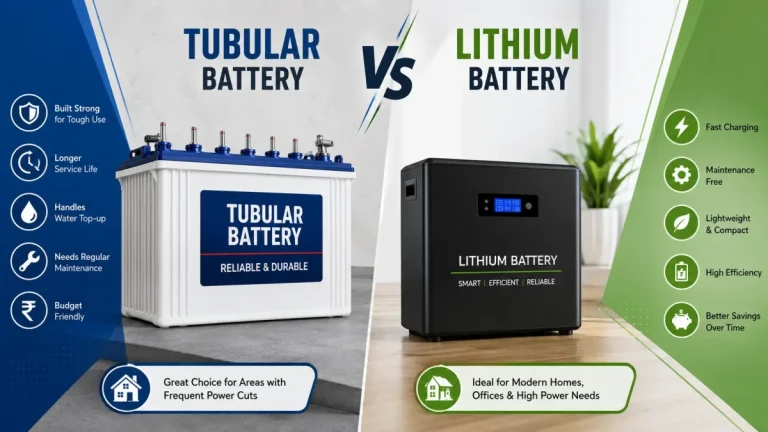
Use tubular versus lithium for the next comparison. Product guides are also available for Exide, Osaka, Phoenix and AGS. Check each model rather than assuming one brand-wide specification.
Example: two batteries with the same nominal energy
Suppose two proposed battery systems each have 5 kWh of nominal storage. Under an illustrative 50% usable-energy assumption, the first provides 2.5 kWh before conversion losses. Under an illustrative 80% assumption, the second provides 4 kWh. These are hypothetical limits, not universal specifications for either chemistry.
If both systems then delivered energy through an assumed 90% conversion efficiency, the corresponding figures would be 2.25 kWh and 3.6 kWh. At a steady 300 W load, simple division gives 7.5 hours and 12 hours respectively. This simplified comparison ignores changing demand, temperature, ageing and reserve interactions; it is not a runtime guarantee.
Now check power. A system can have enough stored energy for the desired duration but an insufficient discharge limit for a pump’s starting demand. Ask the installer to check the continuous and transient load separately rather than increasing nominal capacity without reviewing the bottleneck.
Replace every illustrative assumption with documented model limits before comparing purchase cost. Ask whether the quoted usable figure is measured at the battery or after the inverter, so losses are neither omitted nor counted twice. Keeping that boundary explicit makes two storage quotations much easier to compare.
Frequently asked questions
Can a battery supply a load without an inverter?
Compatible DC loads can use a correctly designed and protected DC system. Ordinary AC household appliances require suitable conversion equipment. Do not connect loads directly without checking voltage, protection and manufacturer requirements.
Does a battery guarantee uninterrupted power?
No. Available energy, power limits, reserve settings, inverter capability and the backup-circuit design determine operation. Test the agreed scenario at handover.
Is lithium always the best value?
Compare the exact usable energy, power, charging needs, compatible equipment, maintenance and warranty against your budget. A chemistry label alone cannot settle the purchase.
Can I compare batteries using only purchase price?
No. Compare the installed systems that meet the same backup requirement, including their operating limits and service obligations.
Sources and limitations
The manufacturer store supports the dated price and maintenance references. Government battery guidance supports the power-versus-energy distinction. Calculations are illustrative, not a prediction of product life or an installation specification.


3 Comments