
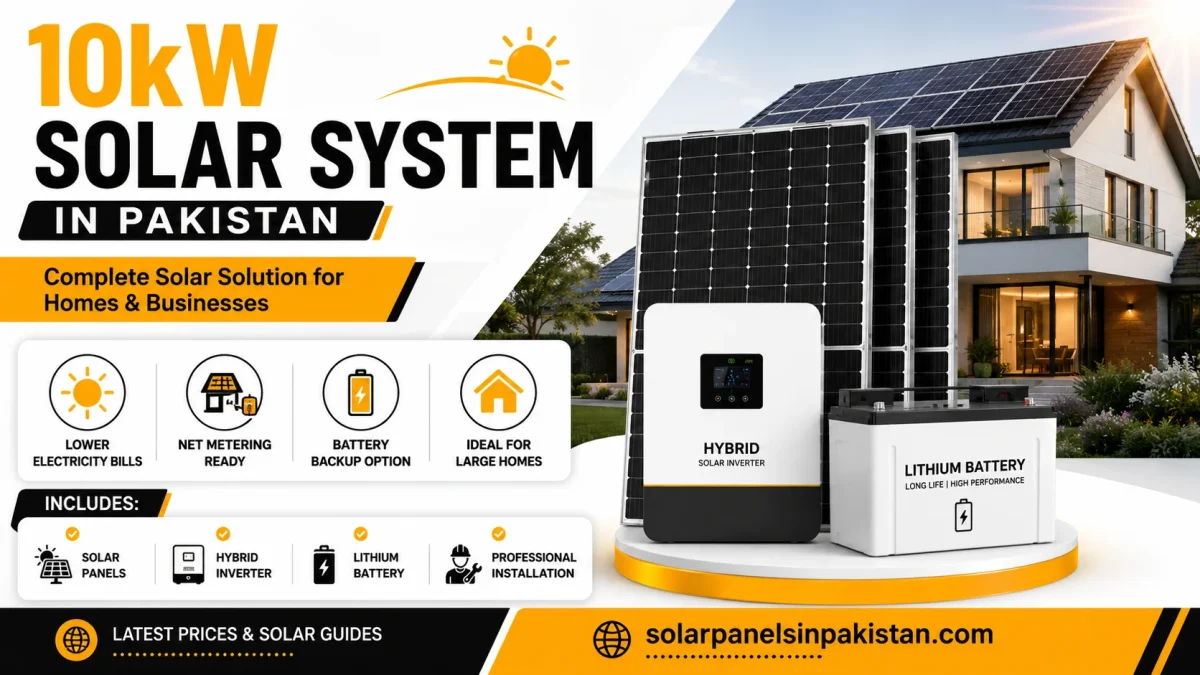
10kW Solar System in Pakistan 2026 – Latest
A 10kW solar system in Pakistan should be assessed using your electricity consumption, daytime demand, roof and backup requirements. A monthly bill amount or house area alone cannot confirm suitability. Check whether the quoted 10kW refers to inverter AC output or panel-array DC capacity.
This guide covers the equipment budget, panel quantities, generation assumptions, load checks, storage and installer questions. An array of eighteen 585W panels totals 10.53kW DC; seventeen total 9.945kW. Larger counts represent larger arrays and require a compatible design.
A 10kW proposal can be considered for homes, offices, shops and other properties, but the following examples are use cases to assess rather than automatic recommendations. Ask for a load assessment and monthly production estimate before choosing the size. The same nominal capacity can cover very different equipment and operating modes.
- Homes with consumption and roof conditions that justify this capacity
- Offices and shops
- Small industries
- Farmhouses
What’s the Price of a 10kW Solar System in Pakistan?
Compare complete quotations for the same equipment and work. This article previously included unsupported first-person installation claims and inconsistent package totals. Those statements have been withdrawn; this website does not present them as verified installation records.
For a transparent panel-only reference, SUNSOLAR lists a Jinko 585W bifacial panel at Rs. 23,400, equivalent to Rs. 40/W, checked on 23 October 2026. Eighteen panels calculate to Rs. 421,200 for 10.53kW DC. This excludes the inverter, batteries, structure, electrical work, labour, transport and any connection-related costs. It is one dealer reference rather than a nationwide installed-price average.
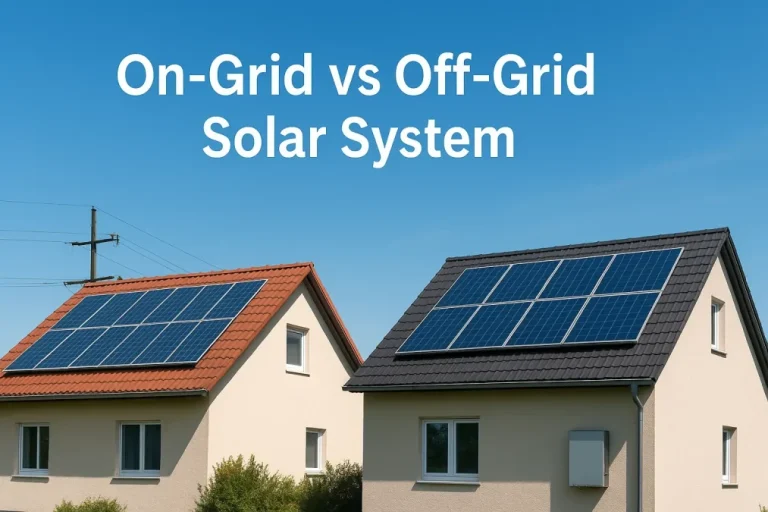
- On-grid systems
- Request a current written on-grid quotation.
- Compare an on-grid proposal separately from packages including storage.
- Hybrid systems
- Request a current written hybrid quotation with a specified battery.
- Identify the hybrid operating modes, compatible storage and backup circuits.
- Off-grid systems
- Assess storage and any supplementary supply for periods of low solar production.
- Request a site-specific off-grid quotation.
Ask for separate on-grid, hybrid and off-grid quotations if you need to compare operating modes. Storage size and inverter functionality can change the budget substantially, but there is no fixed price ranking for every possible package.
Record all model codes, quantities, warranties and exclusions. Compare usable battery energy as well as discharge power. A low package total can be misleading if it excludes the equipment required for your intended backup loads. Confirm a current written quote before paying.
| Quotation component | What to verify |
|---|---|
| Panels | Exact model, rated watts, quantity, total DC capacity and panel-only price. |
| Inverter | Model code, AC output, backup mode, MPPT limits and compatible batteries. |
| Storage | Usable kWh, discharge power, warranty conditions and installed quantity. |
| Structure | Roof assessment, mounting scope, access and maintenance clearances. |
| Electrical work | Cabling, protection, earthing and commissioning specified by the designer. |
| Labour and delivery | Transport, unloading, installation, testing, tax treatment and exclusions. |
| Connection work | Current utility procedure, metering scope and separately stated charges. |
| After-sales service | Who handles a fault, response arrangements and charged visits. |
Factors Affecting the Price
- System Type – On-grid, off-grid, or hybrid design.
- Solar Panel Brand – Compare exact models, datasheets and written warranty terms; Tier-1 is not a universal efficiency or warranty guarantee.
- Inverter Quality – Monitoring features and operating specifications differ; verify the exact model and compare its installed cost.
- Battery Selection – Compare the particular chemistry, usable energy, power, installation requirements and written warranty. Broad battery labels do not establish a universal price or safety ranking.
- Installation Costs – Wiring, mounting frames, earthing, labour, and approvals also add to the total cost.
- Location – Prices vary depending on the city, transportation, and service availability.
- Net metering approval
Types of 10kW Solar Systems
- On-Grid Solar System
- Connected to the WAPDA grid
- No batteries required
- Assess daytime self-consumption and remaining imports
- Any export arrangement requires current eligibility and utility approval
- Hybrid Solar System
- Works with the grid + batteries
- Provides backup during load shedding
- Assess against your specific outage and usage requirements
- Off-Grid Solar System
- Completely independent
- Requires batteries
- Consider where grid-independent operation is required
On-Grid, Hybrid, or Off-Grid — Which Should You Choose?
Choose the operating mode around actual consumption and resilience needs. A grid-connected system without suitable backup equipment should not be assumed to power a building during an outage. A hybrid system also needs a documented configuration and compatible storage for the backup service promised.
Do not assume that exported units receive the same value as imported units or that a household bill will fall to zero. Check the current official arrangement, eligibility and applicable tariff for your connection. Remaining imports, fixed charges, timing of use and seasonal production affect the result.
An off-grid design needs particular attention to the days and hours when solar production is low. Ask how storage and any supplementary source cover critical loads. A designer should explain the operational trade-offs before presenting a payback calculation.
How Many Panels Does a 10kW Solar System Need?
Divide the required DC wattage by the selected panel wattage. For at least 10kW DC, eighteen 585W panels total 10.53kW; seventeen total 9.945kW and fall slightly short. Twenty 585W panels total 11.7kW, not 10kW.
Other examples are seventeen 610W panels = 10.37kW and twenty-five 400W panels = 10kW. Panel counts are not wiring instructions: the designer must verify string voltage, current, MPPT allocation and the inverter limits for the exact equipment. Product and performance warranties vary by model, market and written terms.
How Many Units Does a 10kW System Generate Per Day?
Request a site-specific monthly generation estimate instead of a fixed national daily promise. Location, weather, orientation, shading, temperature, equipment and system losses all matter. Ordinary daylight duration is not the same as equivalent peak-sun-hours.
For illustration only, a 10kW array × an assumed 4 peak-sun-hours × an assumed 0.8 factor gives 32kWh. This is arithmetic with hypothetical inputs, not measured production or a forecast for a Pakistani city. Use a documented modelling method and appropriate local weather data for a proposal.
Review soiling and maintenance using actual conditions and equipment instructions. This article does not establish a universal dust-loss percentage or washing schedule. Arrange safe access; homeowners should not climb onto roofs or work on electrical equipment to investigate an output change.
10kW Solar System Load Capacity
Separate array capacity, inverter continuous AC output and battery discharge power. These limits answer different questions. A 10kW DC label does not promise that an arbitrary list of appliances can run together, at night or during a grid outage.
Make a schedule of loads, actual electrical demand, starting requirements and hours of use. Then identify essential backup circuits. Ask the designer to demonstrate that the inverter, battery and protection scheme support those loads in each intended operating mode. Backup performance must be assessed separately from annual energy production.
- Daily production: changes with site and weather; use a documented estimate.
- Monthly production: request twelve monthly values reflecting seasonal variation.
- Annual production: review the model inputs, losses and uncertainty.
What Can a 10kW Solar System Run?
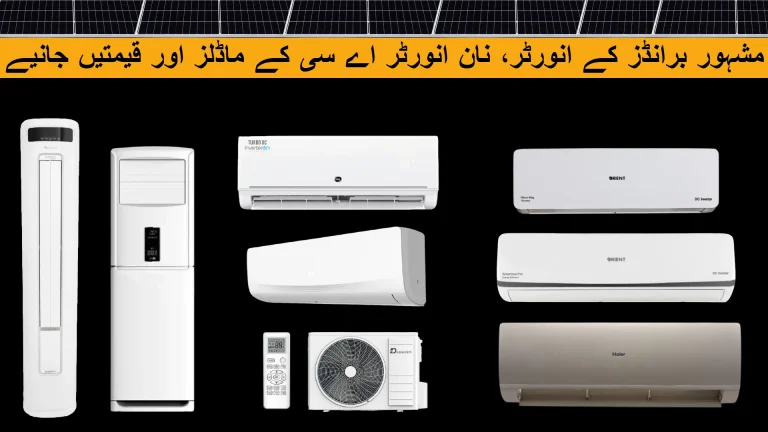
Use the appliances below as a checklist for a load assessment. Their presence in a home does not establish that 10kW is the right size. Record each actual model and which items operate together. Air-conditioner cooling capacity in tons is different from electrical input power:
- 1.5 ton inverter AC (1)
- 1 ton inverter AC (1)
- Refrigerator
- Ceiling fans throughout the house
- LED lights
- Water motor
- TV, washing machine, and other standard appliances
For an office, assess air conditioners, computers, lighting and other equipment from their actual electrical demand and operating schedule. The number of people or AC units alone is insufficient. Compare a 15kW proposal only if the consumption, roof and economic assessment support the larger capacity, rather than assuming it is automatically better.
Benefits of a 10kW Solar System
- Reduced Electricity Bills – Major savings in the long run.
- Reliable Backup – Hybrid and off-grid systems provide power during load shedding.
- Eco-Friendly – Clean, renewable energy reduces dependency on fossil fuels.
- Warranty planning – compare the exact written product, performance and workmanship terms separately.
- Return assessment – calculate savings and costs from stated assumptions; no universal payback period is established here.
What Can Run on a 10kW Solar System?
- Home Appliances:
- 2–3 Air Conditioners (1.5 ton each)
- 1 Refrigerator
- 1 Deep Freezer
- LED TVs (2–3)
- Washing Machine
- Microwave Oven
- Water Pump
- Fans (8–10)
- Lights (20–30 LED bulbs)
- Office / Commercial Use:
- Computers (5–10)
- Printers
- Lighting system
- CCTV cameras
- Small machinery
How many AC can run on a 10kw solar system in Pakistan?
There is no universal AC count or seven-hour runtime for every 10kW system. Check the specific air conditioners, simultaneous appliances, inverter output and available solar power. Starting behaviour and part-load consumption vary by model and conditions.
For night-time or outage operation, the battery must provide sufficient usable energy and discharge power. Ask for the loads and assumptions behind any runtime promise. The system nameplate by itself cannot verify that several ACs and a water pump will operate together.
How Much Does a 10kW Solar System Save in Pakistan? Cost, ROI & Monthly Bill Reduction
Savings depend on self-consumption, remaining electricity imports, your applicable tariff and any separately verified export credits. This page does not claim a universal Rs. 50,000–55,000 monthly saving or a guaranteed payback period.
Compare the same annual consumption and generation assumptions for each quotation. Account for maintenance, financing and possible component replacement. A panel performance warranty is not a warranty for every system component and does not mean that electricity is cost-free after an assumed payback date.
What to Check Before Buying Panel Authenticity, Warranty, and Safety
Ask for the full model codes, serial numbers, invoice and written warranty route. Match the equipment delivered with the quotation and use the manufacturer verification channel where available. A barcode, brand name or Tier-1 label alone is not proof of authenticity or a particular warranty length.
- Panel authenticity: Check the full model and serial numbers against manufacturer records where available. Retain the invoice and applicable warranty terms. Do not infer a warranty length from the Tier-1 label.
- Inverter warranty: Compare the named warranty provider, duration, exclusions and service route for the exact model. Confirm whether labour, visits and transport are included.
- Battery warranty: Request the model-specific written terms, including operating conditions and any energy-throughput or cycle limits. Keep purchase and serial-number records.
- Safety kit: Ask a qualified designer to document required protection, earthing, isolation, cable routing and battery installation conditions. The actual equipment instructions and applicable local requirements determine the design; this article is not an installation specification.
Challenges In Implementations
- High Initial Investment – Not everyone can afford the upfront cost.
- Battery Expense – Lithium batteries make systems more costly, despite their efficiency.
- Skilled Installation – Poor artistry can reduce performance and shorten system life.
- Approval Delays – Net metering and government paperwork sometimes slow down the process.
- Follow a site-specific maintenance plan and equipment instructions
Installation Process of a 10kW Solar System
- Site Survey
- Check the roof space and sunlight availability
- System Configuration
- Load calculation
- Panel placement planning
- Installation
- Mounting structure setup
- Panel installation
- Wiring and inverter connection
- Testing
- System performance check
- Net Metering Application
- Approval from DISCO (for on-grid systems)
How to Compare Installers for a 10kW Solar System
Compare the installer’s documented scope, competence and after-sales responsibilities as well as the price. Ask for references from comparable installations and check relevant credentials against current official requirements. Do not treat an unsupported claim of certification as verified.
Request a roof layout, equipment schedule, design checks, protection details, commissioning plan and written workmanship terms. Ask who resolves a fault and whether transport or site visits cost extra. A cheaper quotation is not automatically defective, and a higher price does not itself prove quality.
The earlier first-person repair stories and specific repair-cost claims were not supported by records and have been removed. Assess the actual proposal and evidence supplied by the installer before signing.
Solar Energy Companies In Pakistan
When comparing solar companies, request quotations for the same design and check current business details, relevant credentials and service coverage. This page does not rank installers or claim independent testing of their work. Ask for customer references you can verify, a named warranty provider and a clear complaint route.
Check the invoice issuer and the business responsible for installation before paying. Equipment supply, manufacturer warranty and workmanship service may involve different organisations. Record those responsibilities instead of assuming that a familiar brand handles every part of the installation.
- Reon Energy Limited – verify current project scope and local service before requesting a quotation.
- Sky Electric – confirm the exact equipment and support offered in your area.
- Premier Energy – check current service coverage and request an itemised quote.
- Inverex Solar – confirm whether your supplier and installer are the same business.
- Pantera Energy – verify current business details and available services.
- For Tesla Industries Pakistan or any other provider, verify the exact equipment, business identity and installation responsibility before paying.
Conclusion – Is a 10kW Solar System Worth It in Pakistan?
A 10kW system may be worth considering where consumption, roof suitability and operating requirements justify it. The decision should come from a realistic comparison of equipment cost, usable generation and remaining electricity expenses, rather than a fixed savings promise.
Collect bills showing kWh, list daytime loads and decide which circuits need outage backup. Compare at least two itemised proposals on the same basis. Ask for monthly generation assumptions, documented compatibility and written service terms.
The solar load calculator can help organise an initial appliance estimate, but it does not produce a final electrical design or guarantee a system size. Have a qualified professional review the actual site and selected equipment before installation.
Related guides for your next decision
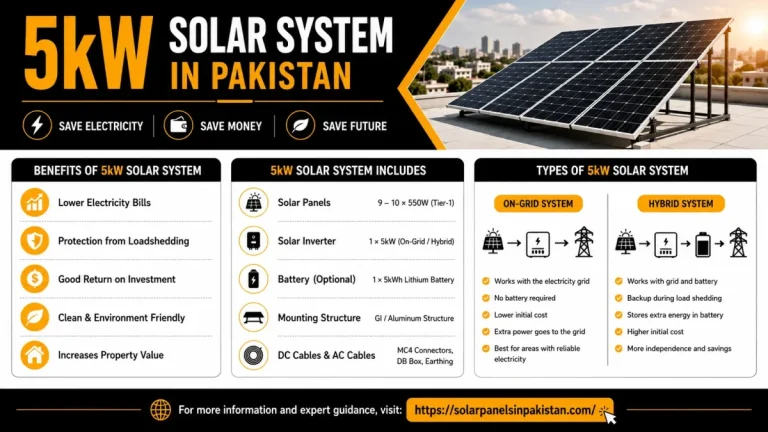
Start with your appliance demand, roof conditions and backup needs before comparing system sizes. To explore the next design decision, read Best Solar AC In Pakistan and 5KW Solar System Price In Pakistan. Compare current solar panel prices by brand and wattage when preparing your itemised equipment budget.
Comparing a larger array? Read our 20kW solar system price and planning guide for panel-count calculations, battery sizing questions and an itemised quotation checklist.
References checked 23 October 2026: SUNSOLAR Jinko 585W product price and Department of Energy solar and resilience background. Prices are dated references and calculations are illustrative, not guarantees.

6 Comments