Panels, budget and backup planning for a 20kW solar system
Published 23 October 2026 · Panel-only reference and clearly labelled planning examples
20kW solar system price: compare the complete scope
There is no single installed price that covers every 20kW solar project in Pakistan. An on-grid quote without storage and a hybrid quote with a large battery bank contain different equipment. Ask for the exact panel array, inverter, mounting, protection, cabling, labour and connection-related work before comparing the totals.
This guide provides transparent panel-budget calculations and a practical quotation checklist. It does not present a made-up nationwide installation average. Equipment model, site conditions, battery needs and the supplier’s current written terms determine the amount you actually pay. Keep the price date and exclusions beside every figure you compare.
How many solar panels are needed for 20kW?
Divide the target DC wattage by the chosen panel wattage, then round up if the target must be met. With 585W panels, 20,000 ÷ 585 is approximately 34.19, so 35 panels total 20,475W, or 20.475kW. Thirty-four of the same panels total 19.89kW and fall slightly short of a 20kW DC target.
Other arithmetic examples are 34 × 600W = 20.4kW, 33 × 620W = 20.46kW and 32 × 645W = 20.64kW. These counts establish only nameplate array capacity. They are not recommended string designs. The qualified designer must check the exact module specifications and inverter input limits.
A dated panel-only budget example
SUNSOLAR’s published rate board checked on 23 October 2026 lists a Jinko 585W N-Type bifacial example at Rs. 40 per watt. At that reference rate, one panel calculates to Rs. 23,400 and 35 panels to Rs. 819,000. This is the panel-only subtotal for a 20.475kW array, not a complete installed 20kW system quotation.
Request a current seller quote for the full model code and quantity. Confirm delivery, taxes, stock and warranty service. A published rate board is one dealer’s reference, not a national average. If your quote uses a different wattage or rate, recalculate the subtotal instead of substituting another product’s price.
20kW on-grid vs hybrid system
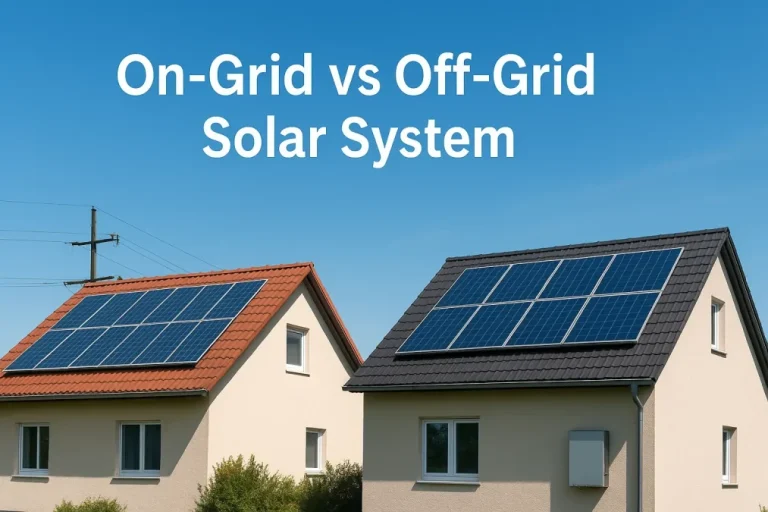
For an on-grid proposal, ask how the inverter operates with the network and during an outage. Do not assume that exporting solar energy provides backup when the grid fails. Any connection and billing arrangement must be checked against the current rules and the requirements of the responsible electricity company.
For a hybrid proposal, identify the supported battery system, usable storage energy and backup circuits. The inverter’s normal AC rating may not answer every backup-output question. Compare the same intended operation across quotes; a lower package price may simply exclude the storage and work required for your actual needs.
Inverter rating and panel capacity are separate
A 20kW inverter rating describes one aspect of the equipment. The connected DC array can have a different nameplate capacity if the manufacturer’s design limits permit it. Check the datasheet for voltage, current, MPPT arrangement and supported oversizing rather than assuming any panel count can be connected.
Ask the designer to document the proposed strings and how the limits are checked. Roof orientations, shading and module characteristics influence that design. This article intentionally does not provide a universal wiring diagram because changing the panel or inverter model changes the calculations and safety requirements.
How many units will a 20kW system generate?
Generation depends on location, weather, orientation, shading, temperature, system losses and availability. A 20kW rating does not mean 20 units every hour or the same daily production throughout the year. Request a location-specific estimate with monthly figures and the assumptions behind the calculation.
For illustration only, 20kW × an assumed four equivalent sun-hours × an assumed 80% overall factor gives 64kWh. This is an arithmetic scenario, not a forecast for your roof or a guaranteed output. Change the assumptions and the result changes. Do not use a single sunny-day screenshot as an annual production promise.
Roof space and structural assessment
Use the dimensions and quantity of the exact proposed panel. As a purely geometric example, 35 hypothetical modules each measuring 2.3m × 1.13m have approximately 90.97m² of combined module area. That is not the required roof area: access, setbacks, row spacing, mounting and shadows need additional consideration.
Have the site assessed for structural suitability, wind conditions, safe access and the mounting arrangement. A large empty roof is not automatically a suitable installation surface. Include obstacles, water tanks and maintenance routes on the layout before treating a panel-count calculation as a practical design.
Battery size for a 20kW solar system
Choose storage around the loads that need backup and the required hours, rather than matching a battery number to the array’s 20kW label. A business wanting two hours of essential lighting and computers has different needs from a property expecting overnight air-conditioning or heavy motor operation.
A hypothetical average 2kW backup load for five hours needs 10kWh at the loads before allowing for losses and reserve. The selected battery must also meet power and starting-demand limits. Ask the installer for usable energy, continuous discharge power, compatible models and the conditions supporting the runtime estimate.
What a good installation quote should include
Record panel model, wattage, quantity, inverter code, battery details if relevant, mounting scope, cable and protection design, commissioning and service responsibility. Put delivery, taxes and connection-related work on clearly identified lines. Mark exclusions instead of hiding them inside a broad “complete package” description.
Compare product warranty and workmanship terms separately. Ask who handles a fault, what documents are required and whether transport or visits cost extra. A long performance warranty on a panel is different from a promise to replace every system component or provide free site service for the same period.
Net metering and approval questions for 20kW
Check whether the “20kW” on the quote refers to the relevant facility rating for approval purposes. The approval rules should be applied to the documented design and connection, not a sales nickname. Ask the electricity company what procedure and supporting documents apply before relying on export income.
Our Net Metering guide explains verified 2026 amendments, including the distinction between utility approval and NEPRA concurrence for facilities up to 25kW. Read that guide with the official documents and your own connection details. A fee exemption is not permission to skip technical review, metering or other required work.
Is 20kW suitable for your home or business?
Start with consumption and the times loads run. Compare recent bills with a daytime demand profile, then consider available roof space and future changes. A larger system does not automatically produce better value if energy cannot be used, stored or exported as assumed in the proposal.
Ask for a smaller-system comparison as well as the 20kW option. Review upfront cost, remaining imports, maintenance, storage replacement and any financing commitment. Keep savings estimates conditional on their assumptions. For a smaller starting point, compare the 10kW guide; for the equipment budget, use the brand and wattage price references on our homepage.
20kW solar system FAQs
Can a 20kW system run several air conditioners?
Check the actual simultaneous appliance demand and inverter output rather than counting AC units alone. Cooling capacity is not electrical consumption, and a motor’s starting demand can differ from its running load. Ask for a documented load assessment.
Does 20kW mean unlimited night-time backup?
No. Night-time supply requires suitable storage or another available source. Choose the battery using required energy and discharge power, then check compatible equipment and backup circuits.
Should I compare the cheapest package first?
Compare an identical equipment schedule and site-work scope first. A cheaper quote may exclude a battery, taxes, delivery or protection. Written warranty and the service route also affect the decision.
Sources and related research
Price reference: SUNSOLAR published rate board. Performance-estimation background: NREL PVWatts manual. Illustrative calculations above are not measured results or an electrical design.
Continue with 10kW system planning, Net Metering rules, lithium battery capacity and solar panel prices by brand.