
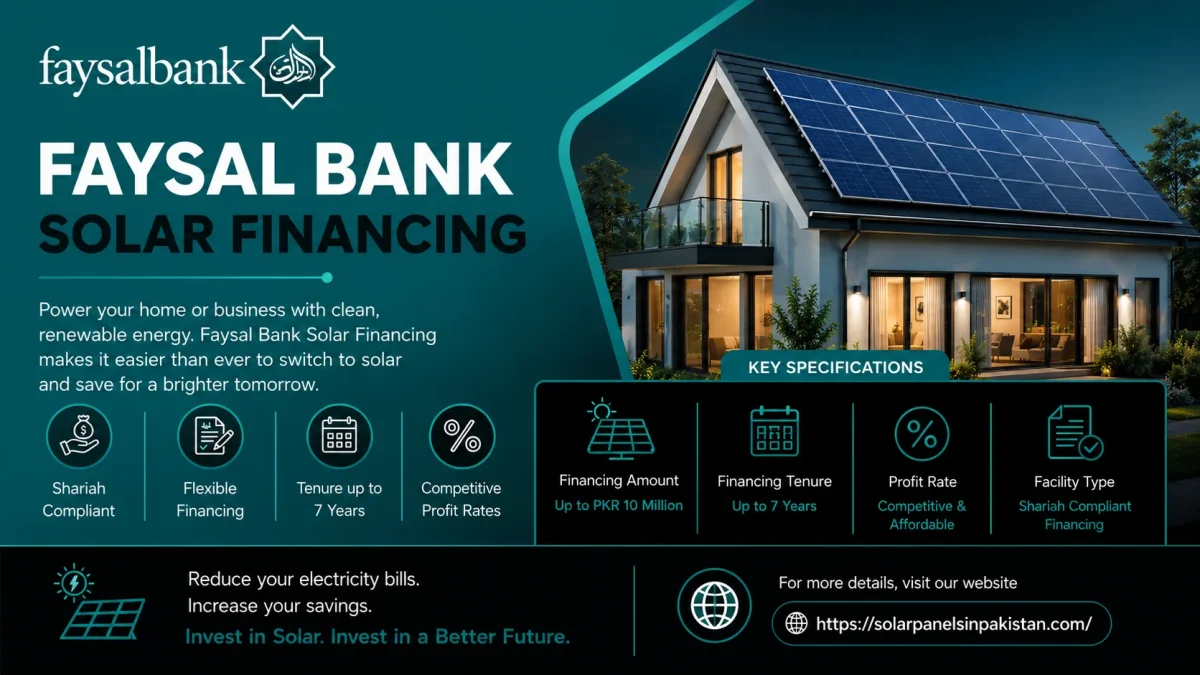
Faysal Bank Solar Financing – Updated Guidelines
Faysal Bank solar financing enables consumers to use green energy, thereby reducing their monthly electricity expenses. The solar energy system is a long-term investment that delivers energy benefits. Initially, people needed to invest a considerable amount in it. Many banks in Pakistan, such as Al Baraka Green Energy Solar Financing and the Bank of Punjab, offer a range of products to encourage solar adoption. Instead of taking a conventional loan, the bank purchases the solar system and sells or leases it to the customer at an agreed price. The customer then pays in instalments over a fixed period.
It is essential to provide information about financing options for solar consumers on the solar panel’s website. We discuss the maximum solar financing options available from banks here, including their terms and conditions. All the information was gathered from the bank’s official websites and through physical visits to enhance financial awareness.
Like many other financial institutions, Faysal Bank offers solar home financing under the Islamic structure of diminishing musharaka. Faysal Bank provides Shariah-compliant solar financing, allowing individuals and businesses to install solar systems without paying the full amount upfront. This financing solution is becoming increasingly popular among Pakistani consumers seeking to reduce their electricity bills while adhering to Islamic financial principles. Here are the key features & benefits of Faysal Bank’s solar financing product. In this complete guide, you will learn everything about Faysal Bank solar financing, how it works in Pakistan, eligibility criteria, benefits, and why it is becoming a popular choice among Pakistani consumers.
Why is Solar Financing Important in Pakistan?
Pakistan faces continuous challenges related to electricity shortages and rising tariffs. Many households struggle with high monthly bills, especially during the summer when electricity usage increases. Solar systems offer a long-term solution, but installation costs can range from PKR 500,000 to several million, depending on system size. This is where solar financing becomes important.
Faysal Bank solar financing allows customers to shift to renewable energy without financial pressure. Instead of paying a large amount at once, customers can spread the cost over several years while enjoying immediate savings on electricity bills.
Key Features of Faysal Bank Solar Financing
Why Choose Faysal Bank Solar Financing?
Unlike traditional loans, Faysal Bank solar financing is specifically designed for individuals and organisations looking to invest in clean energy. It combines affordability, flexibility, and Shariah compliance, making it a preferred choice for those seeking long-term energy independence without compromising ethical banking principles.
How Much Does Solar Cost on Instalments in Pakistan?
A typical 5-kW to 10-kW solar system, the sweet spot for a middle-class Pakistani household, will cost somewhere between PKR 8 and 20 lakh, depending on the brand, installer, and whether you want a hybrid system with battery backup.
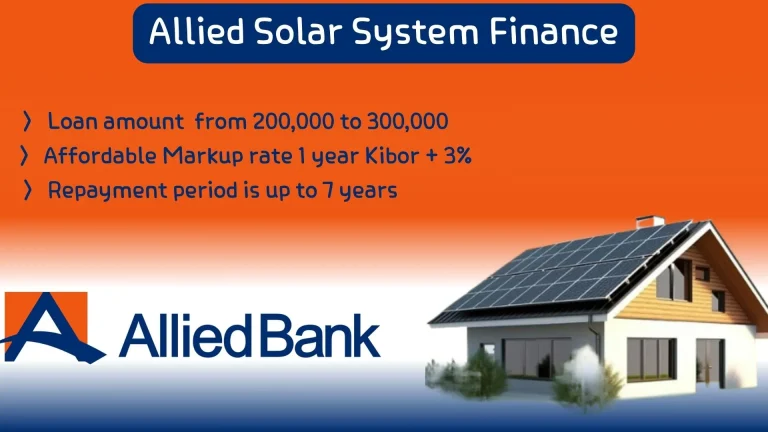
Under Faysal Bank’s Solar Ease product, you can finance between PKR 1 lakh and PKR 1 crore with a tenure of up to 7 years. Most customers end up on a 5-year plan. You need to arrange at least 15% as equity (down payment) yourself. The bank does not finance 100%.
What are the eligibility criteria for Faysal Bank Solar Financing?
- For Individuals (Residential Use):
- Pakistani citizen with a valid CNIC.
- Minimum age: 21 years, maximum: 60 years at loan maturity.
- Proof of income (salary slip, bank statement, or business record).
- Property ownership documents (if installing solar on your own house).
- For Businesses/Commercial Entities:
- Valid business registration.
- Financial statements or bank statements for proof of income.
- NTN and tax compliance.
- For Agricultural Customers:
- Land ownership documents.
- Agricultural income proof.
- Feasibility report for solar-powered tube wells.
What Documents Do I Need for Faysal Bank Solar Financing?
- Copy of CNIC, Recent passport-size photographs
- Salary slip or business income proof
- Bank statement (last 6 months)
- Electricity bill
- Solar system quotation
What Is the Interest Rate for Faysal Bank Solar Financing?
Faysal Bank’s Solar Ease product uses a variable profit rate structured as follows: for salaried customers: 1-Year KIBOR + 3%, and for Self-employed professionals/businessmen: 1-Year KIBOR + 3.5%. With KIBOR currently around 13–14%, the effective rate works out to approximately 16–17.5% per annum. This is a variable rate, meaning it adjusts when KIBOR changes. If interest rates fall, your EMI could reduce. If rates rise, it could increase. Always ask the bank for the current KIBOR rate and your exact profit rate at the time of application.
How can I apply for Faysal Bank solar financing?
To apply, send a message (“ISS” space “city name” space “CNIC”) to 9181 or visit the nearest branch of Faysal Islami Bank. The application process is simple and customer-friendly:
- Initial Inquiry: Visit your nearest Faysal Bank branch or their official website.
- Submit Application: Submit your financing application along with required documents such as CNIC, income proof, and utility bills.
- Provide documents: CNIC, proof of income, property ownership documents, and vendor quotation.
- Bank Evaluation: The bank will verify your documents and financial eligibility.
- Vendor Selection: You must select a bank-approved solar company. The vendor provides a quotation for the system.
- Financing Approval: Once approved, the bank arranges the installation through the selected vendor. The customer then starts paying monthly instalments as per the agreed plan.
- System Installation: Solar panels and equipment are installed at your property.
Common Mistakes That Kill Most Solar Loan Applications
Before applying for solar financing, it is important to evaluate your energy needs and financial situation. In my experience reviewing loan files, the single most common and most avoidable reason for rejection is this: People take a small emergency loan of PKR 3,000 or PKR 5,000 from a mobile wallet. Life gets busy. They forget to pay it back. Three months later, they walk into a bank to apply for a PKR 15 lakh solar loan, and the credit officer pulls their ECIB report. That tiny default shows up. Application rejected.
The ECIB (Electronic Credit Information Bureau) report tracks your entire credit history across all registered lenders, including microfinance institutions and mobile financial services. A default anywhere on that report raises an immediate red flag. Other common reasons I saw applications fail.
- High debt burden — too many existing loans relative to income
- Lower or irregular cash inflow — inconsistent bank statement credits
- Outdated documents — expired CNIC, old salary slips, mismatched addresses
- Misuse of previous loans — funds used for purposes other than stated
- Bad reputation with previous lenders — word travels in the banking community
Can I Get Solar Financing with an Average Income?
The bank’s official minimum income requirement for salaried persons is 1,00,000 per month, and for Self-employed: PKR 1,50,000 per month. In my opinion, after all your monthly household expenses, rent, food, school fees, utilities, and fuel, you need at least PKR 40,000 to 50,000 left over to comfortably service a solar loan. Banks apply a debt burden ratio of approximately 50%. This means your total monthly loan repayments (including the solar EMI) should not exceed 50% of your net income. So if your salary is PKR 80,000 and you already have a car loan or personal loan running, you are likely to face problems. If your salary is PKR 1,20,000 with no existing debt, you are in a good position.
Business income borrowers: Banks will want to see proven, documented cash inflows, bank statements, tax returns, or audited accounts. Verbal claims of business income are not enough. If your business income is informal and undocumented, the application will struggle.
Benefits of Choosing Faysal Bank Solar Financing
Here Is the Honest Truth About “Saving Money” on Solar EMIs
Every solar company advertisement tells you: go solar and save on your electricity bill. Here is what they do not tell you. For a large portion of Pakistani borrowers, particularly lower-middle-class and middle-class households, the monthly EMI is often higher than their current electricity bill. A household paying PKR 8,000 to 10,000 per month in electricity will likely face a solar EMI of PKR 15,000 to 25,000 per month. On paper, that looks like a bad deal.
So why do they still apply?
Because the goal is not to save money every month. The goal is energy independence. Load shedding, unpredictable bills, and no upfront cash are the reality for millions of Pakistani families. Solar financing gives them access to a PKR 10–15 lakh asset without needing that cash upfront. The “payback period” conversation that finance bloggers love to have is largely irrelevant for this customer segment. They will recover their cost over the loan tenure itself and own the system outright at the end.
For higher-income households with electricity bills above PKR 25,000–30,000 per month, the math does work in their favour from day one.
Types of Solar Systems Covered
- Faysal Bank solar financing supports different types of solar systems based on customer needs.
- On-grid systems are ideal for users who want to reduce electricity bills and benefit from net metering. These systems work directly with the utility grid.
- Hybrid systems are the most popular option in Pakistan. They combine solar panels, batteries, and grid electricity, providing backup during load shedding.
- Off-grid systems are suitable for remote areas where grid electricity is not available. These systems rely entirely on solar energy and battery storage.
Expert Analysis: A Banking Risk Officer’s Perspective
The products across Islamic banks are largely similar. Loan amounts, tenure, and equity requirements are almost identical. So why does Faysal Bank solar financing stand out? Having served as a Banking Risk Officer for over two years, I have closely analysed various consumer financing models in Pakistan. From a risk and financial stability perspective, Faysal Bank Solar Financing stands out for several reasons:
- Shariah-Compliant Procedure:
- The most significant advantage is its Islamic banking model (Murabaha or Diminishing Musharakah). Unlike conventional interest-based loans, this procedure is transparent, ethical, and fully Shariah-compliant, making it a preferred choice for many Pakistani households.
- Manageable Debt Burden Ratio (DBR):
- Based on my expertise in credit risk, Faysal Bank’s structured instalments are designed to keep your Based on my expertise in credit risk, Faysal Bank’s structured installments are designed to keep your Debt Burden Ratio within a safe limit. This means the monthly payments are calculated to ensure they don’t overwhelm your monthly disposable income.
- Extended Financing Tenure:
- With a long repayment period (up to 7 years), the instalments are spread out, making them highly affordable. In many cases, the monthly instalment is almost equivalent to what you would otherwise pay in heavy electricity bills, effectively making the system pay for itself over time.
- Faysal Bank, having a smaller applicant volume for this product, typically processes applications faster.
Conclusion – Faysal Bank Solar Financing
Many banks and solar companies are offering solar consumers financial support through solar loans on easy instalment plans. Many solar consumers are unaware of these bank financing options. The Faysal Bank Solar Financing Program offers Pakistanis a valuable opportunity to transition to renewable energy, alleviating the financial burden of substantial upfront costs. By providing easy instalment plans, extended repayment periods, and quality assurance through approved vendors, Faysal Bank solar financing enables individuals, farmers, and businesses to adopt solar energy. Switching to solar through financing not only reduces monthly electricity expenses but also contributes to a sustainable future. For anyone looking to cut down electricity bills and gain energy independence, Faysal Bank solar financing is a reliable and smart choice.
My Verdict: If you are looking for an ‘easy-to-process’ and ‘low-risk’ financial path to energy independence, Faysal Bank offers one of the most balanced solar products in the current market.”
My Honest Advice Before You Walk Into Any Bank: Banks will only give you this loan if four things are true:
- You have solid, documented income
- Salaried with payslips, or a business with proven bank transactions.
- Your credit history is clean
- No defaults, anywhere, including that old loan you forgot about.
- Your documents are original and up to date
- Valid CNIC, recent salary slips (last 3 months), latest utility bill, property documents for the installation site.
- Your purpose is clear
- Solar system installation with a vendor quotation. Banks do not like vague loan purposes.

Frequently Asked Questions About Faysal Bank Solar Financing
What is the minimum salary required to apply for Faysal Bank Solar Financing?
The minimum income required for a salaried person is 100,000 PKR
What is the minimum income necessary for Faysal Bank Solar Financing?
The minimum income required for a self-employed person is 150,000 PKR
How can I apply for solar financing from Faysal Bank?
To apply, send a message (“ISS” space “city name” space “CNIC”) to 9181 or visit the nearest branch of Faysal Islami Bank.
What is the interest rate offered by Faysal Bank for solar financing?
Interest rates may vary by product. But the product’s annual profit rate is 6%.
Is Faysal Bank an Islamic bank?
Yes, Faysal Bank offers both Islamic and conventional banking services.
Does Faysal Bank offer interest-free solar financing?
Yes, Islamic (Shariah-compliant) interest-free financing options are available.
Faysal Bank Solar Financing: documents required?
CNIC, income proof, utility bills, and solar supplier quotation.
Faysal Bank solar financing tenure?
Financing tenure is from 1 to 7 years
I want to apply for solar
Respected Sir, the Bank’s official website links, which are underlined in the article, can be accessed through the official website for the application.
Enjoyed reading through this, very good stuff, thankyou. “It requires more courage to suffer than to die.” by Napoleon Bonaparte.