
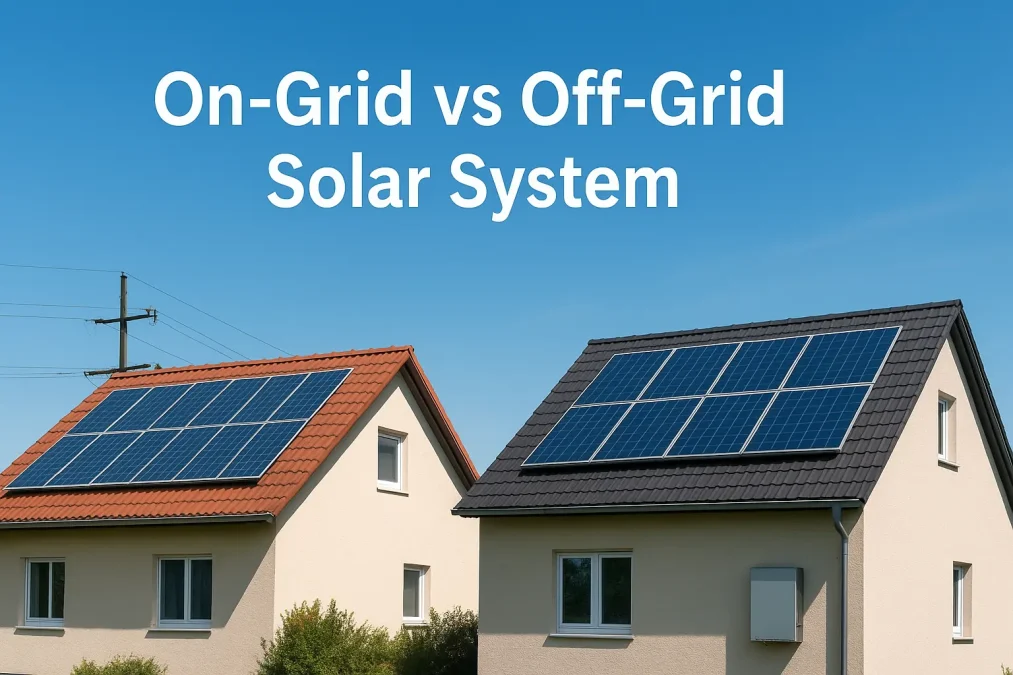
On-Grid vs Off-Grid vs Hybrid Solar Systems in Pakistan
Choose a solar system by the job it must do: reduce daytime grid purchases, supply essential circuits during outages, or operate where no grid connection is available. A panel array alone does not answer all three needs. This guide explains the operating differences and the questions that make installer quotations comparable.
Editorial review: 11 November 2026. This is a planning guide, not an installation design or a current tariff offer. Export permission, settlement rules and connection requirements must be checked for your own connection.
The three systems at a glance
| Question | On-grid | Off-grid | Hybrid |
|---|---|---|---|
| Grid connection | Required for normal operation | Operates without a utility connection | Can combine grid supply with other sources, depending on model |
| Battery storage | Usually absent in a basic grid-tied design | Normally needed for night use and weather variation | Supported only within the model’s specifications |
| Outage operation | Ordinary grid-tied output shuts down | Limited by available generation, storage and inverter output | Requires a correctly configured backup output and suitable equipment |
| Electricity export | Only with the required approval and configuration | Not part of a standalone design | Not automatic; equipment and connection approval matter |
| Main decision | Daytime self-consumption | Energy availability throughout the year | Essential-load backup alongside grid use |
How an on-grid system works
Panels produce DC electricity, and a grid-tied inverter supplies AC electricity in coordination with the utility supply. The home uses the available solar energy; any remaining demand comes from the grid. Surplus may be exported only where the connection arrangement permits it. Do not assume every exported unit offsets an imported unit at the same price.
A basic on-grid installation usually avoids the purchase and maintenance of a battery bank. Its limitation is outage operation: an ordinary grid-tied inverter stops supplying power when the grid fails. Sunlight on the roof does not by itself make your sockets a safe backup supply.
The relevant disadvantages are dependence on the grid for normal operation, variable solar output, and the need to check approved export arrangements. Battery replacement is not a disadvantage of a system that has no batteries. If a seller promises daytime backup without storage, request the exact model’s documented operating conditions and a demonstration of the proposed circuits.
How an off-grid system works
A standalone system must cover demand without relying on utility imports. Panels, charge-control equipment, storage and an inverter must be designed as a coordinated system. A battery stores energy for use when generation is insufficient; it does not create additional energy.
Off-grid operation can suit a remote property, but it does not guarantee unlimited backup or continuous power. Several cloudy days, a depleted battery or an appliance starting surge can exceed the design. A complete proposal should state the essential daily energy demand, seasonal generation assumption, usable storage and the fallback plan when the reserve is reached.
Compare the lifetime cost of batteries, maintenance, replacement components and any supplementary generator. Where the property also retains a utility connection, its standing charges do not disappear merely because solar is installed.
What a hybrid system adds
Hybrid is a broad product label. Depending on the model, an inverter may manage PV, a battery and grid electricity, but its normal AC rating, backup output and battery charging limits can differ. Some loads may remain outside the protected backup circuits.
Ask whether the equipment can start after a fully depleted battery, whether it needs a grid signal for a particular operating mode, and which battery models and communications protocols it supports. Export capability also requires the appropriate connection approval; it is not granted by the word hybrid on a box.
Start with the outage you need to cover
List the appliances that must operate during an outage. Record watts, the number of appliances, expected running hours and starting requirements. Keep lights, fans and internet equipment separate from optional loads such as an electric heater. Have the installer verify actual nameplate ratings and motor starting demand.
Illustrative backup example: two 75 W fans, four 12 W lights and a 12 W router total 210 W. Running that steady load for three hours needs 0.63 kWh delivered to the appliances. If the planning assumptions are 80% usable battery energy and 90% conversion efficiency, nominal storage is 0.63 ÷ (0.80 × 0.90) = about 0.875 kWh. These are example assumptions, not specifications for a particular battery. Reserve settings, temperature, ageing and surge capability can change the final selection.
Use the appliance and backup calculator to make assumptions explicit, then ask a qualified installer to validate the design.
Daily energy and inverter power are different checks
A home consuming 10 kWh in a day does not necessarily need a 10 kW inverter. Energy measures consumption over time; power measures the rate at a moment. The installer must check simultaneous loads and starting surges separately from the panel array’s expected daily production.
Likewise, two homes with the same monthly consumption can need different systems. A home occupied at lunchtime may directly use more solar energy. A home empty during daylight may need storage or rely on evening grid imports. A monthly bill alone cannot determine panel count, battery size or expected savings.
Compare costs using the same scope
There is no verified national package price in this comparison. Get dated quotations for the same panel capacity, inverter model, backup circuits and storage requirement. A battery-free quotation and a battery-backed quotation are different products even if both are advertised as 5 kW.
- Record panel model, wattage and quantity; multiply them to confirm DC array capacity.
- Record inverter rated AC output, phase configuration, backup output and warranty.
- Record nominal and usable battery energy, permitted discharge power and compatibility.
- List mounting, protection, earthing, cable lengths, labour and delivery separately.
- State whether connection paperwork, inspections and applicable taxes are included.
- Agree commissioning tests, operating instructions and after-sales responsibilities in writing.
For equipment context, read the inverter guide, battery guide and 5 kW system quotation guide.
Check the connection before assuming bill savings
Ask your electricity supplier about the rules that apply to your connection, including sanctioned load, equipment acceptance, approvals and export settlement. Use the connection guide as a starting point and verify current requirements with the responsible provider. A seller’s payback illustration is not a guarantee of future tariffs or approval.
Questions to settle before paying
Will an on-grid system work during load shedding?
A conventional grid-tied installation shuts down. Outage power needs equipment and wiring designed for that purpose. Ask which sockets remain powered and what limits apply.
Does hybrid mean the whole house has backup?
No. Backup output, phase arrangements, battery discharge capability and the protected-circuit design determine what can run. Request a circuit list and a commissioning demonstration.
Is off-grid always the best choice where outages are frequent?
No. Compare a standalone design with a correctly specified hybrid design against your essential loads, available roof area, seasonal energy needs and budget. Frequent outages describe the problem, but do not specify the solution.
Can solar eliminate every electricity charge?
Do not budget on that promise. Grid imports, fixed charges, export settlement, seasonal generation and actual self-consumption all affect the bill.
Sources and scope
The U.S. Department of Energy’s solar resilience guide explains why outage operation requires a properly configured system. Its technical background does not establish Pakistan’s connection rules. The calculations above are transparent examples by Solar Energy Desk; no household case study or measured savings is claimed.
4 Comments