
10kW Solar System in Pakistan 2026 – Latest
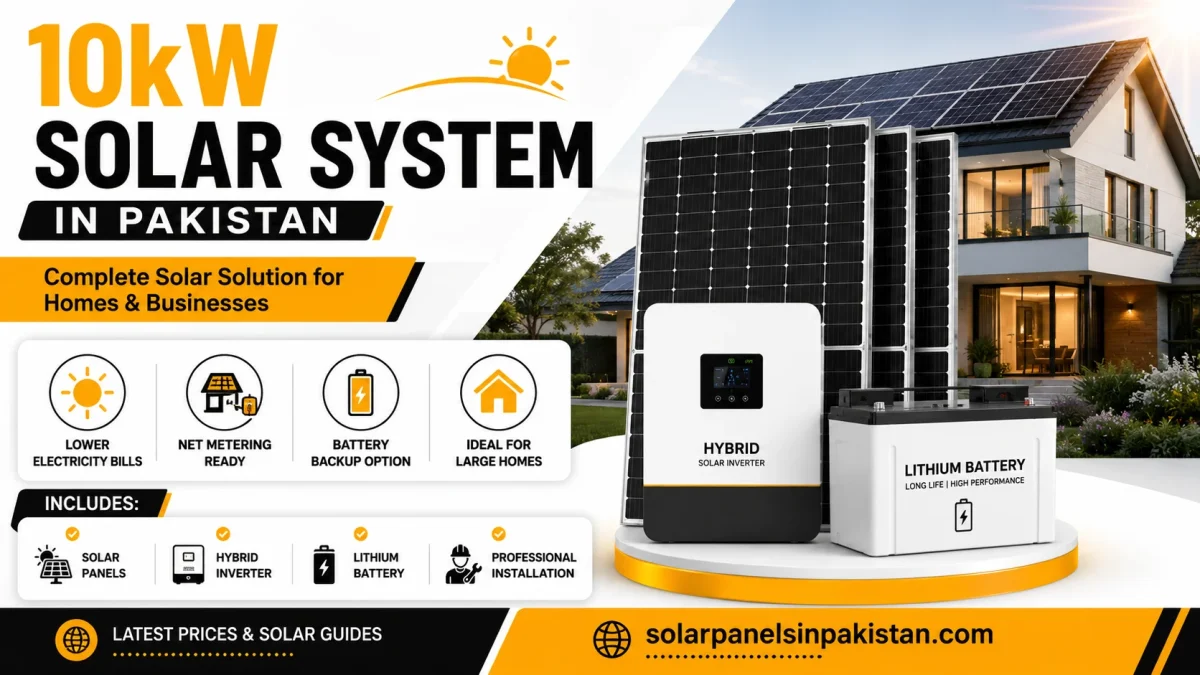
In Pakistan, a 10kW solar system is usually installed for homes spending Rs. 50,000+ per month on electricity. It is one of the most popular system sizes because it can run multiple AC’s and significantly reduce bills, especially after recent increases in electricity prices. It typically consists of around 25–30 high-efficiency solar panels, an inverter, mounting structures, and, depending on the system’s configuration, batteries. In Pakistan, this system size is considered suitable for large homes, small industries, or commercial buildings that face high monthly electricity consumption. With proper installation, a 10kW solar system can produce enough power to run multiple air conditioners, refrigerators, washing machines, fans, and lights, making it an excellent solution for households or businesses looking to reduce bills and secure reliable energy.
In this complete guide, you will learn about the price of a 10kW solar system in Pakistan, its components, installation process, load capacity, and which appliances it can power.
What is a 10kW Solar System?
A 10kW solar system is a solar power setup that produces around 10,000 watts (10 kilowatts) of electricity under ideal sunlight conditions. This system generates enough electricity to run multiple heavy appliances simultaneously. It is suitable for:
- Large houses (10–15 Marla or more)
- Offices and shops
- Small industries
- Farmhouses
What’s the Price of a 10kW Solar System in Pakistan?
If you are searching for the price of a 10kW solar system in Pakistan, you will find plenty of numbers online, and most of them are incomplete. They give you a figure but do not tell you what is actually included, what can go wrong, or what a 10kW system realistically costs when everything is done properly. I have personally installed 10kW solar systems using on-grid, hybrid, and off-grid setups, and I will share the real numbers along with everything I have learned from installations across Pakistan. The price of a 10kW solar system in Pakistan depends on which type of system you choose. Here are the real market prices based on my installations and current market rates:
- On-grid systems
- PKR 13,00,000 – 16,00,000
- The most affordable because they do not require batteries.
- Hybrid systems
- 15,00,000 – 18,50,000
- These combine grid connectivity with batteries and are more expensive.
- Off-grid systems
- Rely entirely on batteries for storage, making them the most costly option.
- PKR 17,00,000 – 20,00,000
I have personally installed all three types. My on-grid 10kW installation came to approximately Rs. 1.5 million, and the off-grid setup with batteries and a larger inverter came to around Rs. 2 million. The difference is almost entirely due to batteries and the inverter type. Off-grid inverters and large battery banks are the most expensive components in any solar system. For most Pakistani homeowners in 2026, on-grid with net metering is the most cost-effective option. Hybrid is the most practical for areas with heavy load shedding.
Components of a 10 kW solar system | Cost of a 10kw solar system |
The estimated price of 18-22 solar panels of 585 watts | 485,000 PKR |
10 kW hybrid inverter price in Pakistan | 550,000 PKR |
All electrical components, like wires, cables, breakers, safety pipes, non-flammable cables, DP | 100,000 PKR |
10 kW solar installation labour cost | 75,000 PKR |
Rooftop solar stand or solar structure (Standard GI Structure) | 110,000 PKR |
Solar batteries (Optional) | 200,000 PKR |
Estimated cost of a 10kW Solar System in Pakistan with Batteries & Hybrid Inverter | 1,520,000 PKR |
Estimated cost of a 10kW Solar System in Pakistan, without batteries and a Hybrid inverter | 770,000 PKR |
Factors Affecting the Price
- System Type – On-grid, off-grid, or hybrid design.
- Solar Panel Brand – Tier-1 international brands cost more but offer longer warranties and higher efficiency.
- Inverter Quality – High-end inverters with intelligent monitoring increase the price but improve performance.
- Battery Selection – Lithium batteries are safer and last longer, but are pricier than lead-acid batteries.
- Installation Costs – Wiring, mounting frames, earthing, labour, and approvals also add to the total cost.
- Location – Prices vary depending on the city, transportation, and service availability.
- Net metering approval
Types of 10kW Solar Systems
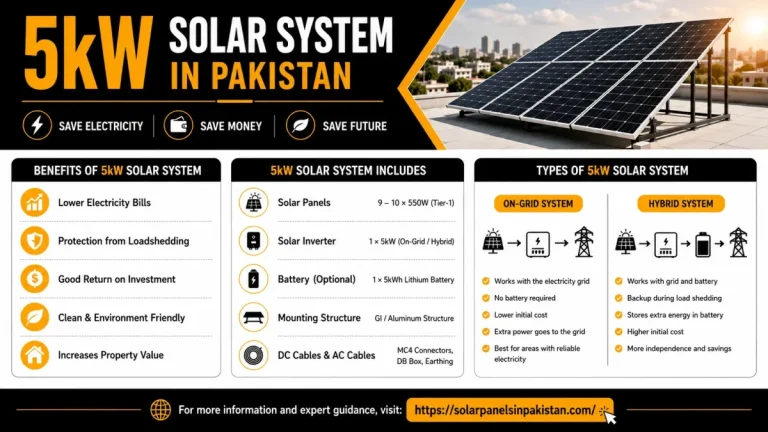
- On-Grid Solar System
- Connected to the WAPDA grid
- No batteries required
- Best for saving electricity bills
- Supports net metering
- Hybrid Solar System
- Works with the grid + batteries
- Provides backup during load shedding
- Ideal for Pakistani conditions
- Off-Grid Solar System
- Completely independent
- Requires batteries
- Best for remote areas
On-Grid, Hybrid, or Off-Grid — Which Should You Choose?
My personal recommendation for most Pakistani homeowners is on-grid with net metering, and the reason is simple: it is the least expensive option, and the net metering facility makes it the smartest financial decision.
With on-grid net metering, any units your system generates that you do not use during the day go back to WAPDA’s grid. Your DISCO credits those units on your next bill. A properly sized 10kW on-grid system in a home with high daytime usage can bring a Rs. 50,000 to Rs. 60,000 monthly bill down to near zero.
Hybrid is the second-best option, and for areas with 8 or more hours of daily load shedding, it may actually be the better choice. A hybrid system gives you battery backup for night use while still allowing net metering during the day. It costs Rs. 300,000 to Rs. 500,000 more than on-grid, but it eliminates the need for a separate UPS system.
Off-grid is only suitable for locations where WAPDA supply is unavailable or completely unreliable, such as farms, rural properties, and remote sites. It is the most expensive option by far because of the large battery bank required.
If your budget is around Rs. 15 lakh, both on-grid and hybrid are manageable and good investments. On-grid gives you faster payback; hybrid gives you more comfort and backup.
How Many Panels Does a 10kW Solar System Need?
A 10kW solar system in Pakistan requires 20 solar panels of 585 watts each, which is the most common panel size in the market right now. You can also achieve 10kW with 17 to 18 panels if you use higher wattage 610W panels, or 25 panels if you use older 400W panels. The panel count depends entirely on the wattage you choose.
The brands I have used and recommend for panels are Longi Solar, Canadian Solar, and Jinko. All three are Tier-1 manufacturers with 25-year production warranties and proven performance in Pakistan’s climate.
How Many Units Does a 10kW System Generate Per Day?
From my installations and my solar panel calculator, a 10kW system generates 35 to 40 units per day under normal Pakistani conditions. This figure depends on three things: how clean your panels are, how well the system is installed, and how much sunlight your city gets.
Cities like Multan, Sukkur, and Bahawalpur get more sunshine and more consistent sun throughout the year compared to Lahore or Islamabad. A system in Multan will outperform the same system in Lahore sometimes by 10 to 15% annually, simply because of more peak sun hours and fewer cloudy days.
Maintenance also matters more than most people realize. Dusty panels in cities like Multan and Faisalabad can lose 15 to 25% of their output if not cleaned regularly. Washing your panels every 2 to 3 weeks in dusty seasons keeps your generation numbers where they should be.
10kW Solar System Load Capacity
A 10kW solar system is designed for homes or offices with heavy power needs, offering a reliable and cost-effective energy solution. A 10kW system can handle heavy residential and commercial loads. It can efficiently run 3 to 4 air conditioners, 2 refrigerators, 15 to 20 fans, 20 to 25 LED lights, 1 washing machine, 1 water pump, and other essential electronic devices simultaneously. On average, it can generate 40 to 45 units of electricity per day, depending on sunlight and the quality of the installation. This capacity is ideal for users who face high monthly electricity bills, typically between Rs. 50,000 and Rs. 80,000. With proper batteries and an inverter, the system also provides seamless backup during power outages. A 10kW solar system not only reduces grid dependency but also enhances energy efficiency and long-term savings for large households or commercial setups in Pakistan.
Electricity Generation of a 10kW Solar System
- Daily Production: 35–45 units (kWh)
- Monthly Production: 1,050–1,350 units
- Annual Production: 13,000–16,000 units
What Can a 10kW Solar System Run?
A 10kW solar system is suitable for a medium-sized Pakistani family home of 6 to 8 people. During peak sunlight hours, it can comfortably run:
- 1.5 ton inverter AC (1)
- 1 ton inverter AC (1)
- Refrigerator
- Ceiling fans throughout the house
- LED lights
- Water motor
- TV, washing machine, and other standard appliances
For an office, a 10kW system can run 3 × 1-ton inverter AC’s along with computers, LED lighting, and other office equipment without any strain.
If you are running more than 2 large AC’s simultaneously or have very high daytime loads, a 15kW system may suit you better. A 10kW system has limits, and a professional installer should calculate your exact load before recommending any system size.
Benefits of a 10kW Solar System
- Reduced Electricity Bills – Major savings in the long run.
- Reliable Backup – Hybrid and off-grid systems provide power during load shedding.
- Eco-Friendly – Clean, renewable energy reduces dependency on fossil fuels.
- Long Life – Panels can last over 20 years, while modern inverters and batteries have 5–10-year warranties.
- Return on Investment – Most users recover their initial investment within 3–5 years.
What Can Run on a 10kW Solar System?
- Home Appliances:
- 2–3 Air Conditioners (1.5 ton each)
- 1 Refrigerator
- 1 Deep Freezer
- LED TVs (2–3)
- Washing Machine
- Microwave Oven
- Water Pump
- Fans (8–10)
- Lights (20–30 LED bulbs)
- Office / Commercial Use:
- Computers (5–10)
- Printers
- Lighting system
- CCTV cameras
- Small machinery
How many AC can run on a 10kw solar system in Pakistan?
A 10kW solar system in Pakistan can comfortably run 2 x 1.5 ton ACs along with regular household appliances like a refrigerator, ceiling fans, lights, and a water pump for about 7 hours during the day without any issue. This system typically generates around 40-45 units per day with good sunlight, which is more than enough to handle this load. However, if the household appliances are reduced, the system can even support 2 x 1.5 ton ACs plus 1 x 1 ton AC simultaneously, as the lower overall load gives the system extra capacity to handle the additional air conditioner comfortably.
How Much Does a 10kW Solar System Save in Pakistan? Cost, ROI & Monthly Bill Reduction
Based on my personal experience and my solar panel calculator, a 10kW solar system saves Rs. 50,000 to Rs. 55,000 per month on electricity bills in Pakistan. This is consistent with what I have seen across my installations. Solar panels carry 25-year production warranties. After your payback period, you are generating near-free electricity for another 20-plus years.
How Long Does It Take to Pay Back a 10kW Solar System?
For an on-grid 10kW system costing Rs. 1.5 million with monthly savings of Rs. 50,000 to Rs. 55,000, the payback period is approximately 2.5 to 3 years. This matches what independent research and real installation data show across Pakistan.
After payback, every rupee saved is pure return. A Rs. 1.5 million investment that pays itself back in 3 years and then runs for another 22 years is one of the best financial decisions a Pakistani homeowner can make right now, especially with electricity tariffs continuing to rise.
What to Check Before Buying Panel Authenticity, Warranty, and Safety
This is something almost no Pakistani buyer asks about, and it is one of the most important parts of any solar purchase.
- Panel authenticity: There are fake and substandard panels in the Pakistani market. Before buying, verify the panel serial numbers with the manufacturer. Longi, Canadian Solar, and Jinko all have online verification tools. A genuine Tier-1 panel has a 25-year production warranty and a 10 to 12-year product warranty. A fake panel has neither and will degrade rapidly within 3 to 5 years.
- Inverter warranty: Inverter brands I have used and recommend include Inverex, Fronus, and Solis. Make sure you get a written warranty document, not just a verbal promise from the installer. A quality inverter should have a minimum 5-year warranty, with many premium brands offering 10 years.
- Battery warranty: Whether you go tubular or lithium, always get a written battery warranty. For lithium batteries, brands I have used include Knox, Narada, Fronus, Inverex, and Pylontech. For tubular, Osaka, Exide, and AGS are reliable. Check that the warranty card is filled in with your name, date, and serial number at the time of installation.
- Safety kit: This is the most overlooked item. A proper 10kW installation must include DC and AC circuit breakers, surge protection devices, proper earthing, conduit wiring, and a fire-rated battery enclosure if you are using lithium. Skipping safety components to reduce cost is one of the most dangerous decisions a homeowner can make. I have seen wiring fires from poorly done installations; it is not a theoretical risk.
Challenges In Implementations
- High Initial Investment – Not everyone can afford the upfront cost.
- Battery Expense – Lithium batteries make systems more costly, despite their efficiency.
- Skilled Installation – Poor artistry can reduce performance and shorten system life.
- Approval Delays – Net metering and government paperwork sometimes slow down the process.
- Solar systems require minimal maintenance
Installation Process of a 10kW Solar System
- Site Survey
- Check the roof space and sunlight availability
- System Configuration
- Load calculation
- Panel placement planning
- Installation
- Mounting structure setup
- Panel installation
- Wiring and inverter connection
- Testing
- System performance check
- Net Metering Application
- Approval from DISCO (for on-grid systems)
The Biggest Mistake Pakistanis Make When Buying a 10kW Solar System
The single biggest mistake I see again and again is choosing the cheapest installer.
A cheap installer takes less money upfront, but what follows almost always costs more in the long run. Non-professional installers do not calculate the load correctly. They do not know how to size the system properly for your actual usage. They are not familiar with the latest inverter and panel technologies. Furthermore, they cut corners on wiring, safety equipment, and earthing. And when something goes wrong, panels tripping from overloading, inverter faults, wiring problems, they are often unreachable.
I have personally fixed other installers’ work multiple times. The pattern is always the same: the homeowner saved Rs. 30,000 to Rs. 50,000 on installation and then spent Rs. 100,000 to Rs. 200,000 resolving issues that a professional installation would never have caused.
The difference between a cheap installer and a professional one shows up in system performance, safety, long-term cost, and peace of mind. It is not a place to cut corners on a Rs. 1.5 million investments.
When choosing an installer, ask for their previous installations, ask to speak to past clients, and check if they are AEDB-certified. Make sure they provide a written breakdown of every component with brand names and model numbers before you pay anything.
Solar Energy Companies In Pakistan
When planning a 10kW solar setup, selecting the right company for supply and installation is as important as selecting quality components. Several trusted solar solution providers operate across Pakistan, offering complete design, installation, and after-sales services. Some recognised solar energy companies in Pakistan are installing 10kw solar systems.
- Reon Energy Limited – One of the largest renewable energy companies in Pakistan, specialising in large-scale and residential projects.
- Sky Electric – Known for innovative solar systems with energy monitoring and lithium battery solutions.
- Premier Energy – An international company providing solar solutions with offices in major Pakistani cities.
- Inverex Solar – Supplies panels and inverters and provides complete solar system solutions.
- Pantera Energy – Focused on hybrid and net-metered systems for homes and businesses.
- Tesla Industries Pakistan offers locally manufactured solar equipment along with installation services.
Conclusion – Is a 10kW Solar System Worth It in Pakistan?
Yes, a 10kW solar system is one of the best financial investments a Pakistani homeowner or small business can make in 2026. With monthly savings of Rs. 50,000 to Rs. 55,000, a payback period of 2.5 to 3 years, and panels that last 25 years, the numbers are compelling by any measure.
The key is getting it right the first time. Buy genuine panels from verified brands. Get written warranties on every component. Hire a professional installer, not the cheapest one. And make sure your system includes proper safety equipment. Do it right, and a 10kW solar system will serve your home or office reliably for 20-plus years. Do it cheaply, and you will spend the next few years resolving problems that should never have existed.
Use the solar panel calculator on this site to calculate your exact load and find out what system size is right for your home before making any decision.


6 Comments