

3kW Solar System Price in Pakistan: Panels, Backup and Quote Scope
A 3kW solar quotation needs two capacity figures: the inverter’s rated AC output and the panels’ combined rated DC capacity. Sellers may use 3kW as a package name even when the array is 3.3kW or 3.51kW. Compare the actual equipment schedule before comparing the headline total.
Reviewed 11 November 2026 by Solar Energy Desk. This guide shows a dated panel-cost example and transparent planning calculations. It does not establish a current national installed-package price or guarantee that a system suits a particular household.
What does 3kW mean?
kW measures power. kWh measures energy used or produced over time. A 3kW inverter does not generate 3kWh continuously, and a 3kW package does not automatically include storage. Ask which number refers to the inverter, which refers to the panels and which battery energy is included, if any.
Do not confuse kW with kVA or kV. kVA is apparent power and kV is voltage. A quotation should use the units on the actual equipment datasheets and explain the AC output relevant to your loads.
Panel counts for a nominal 3kW target
| Module wattage | Panels to meet or exceed 3kW arithmetically | Rated DC array |
|---|---|---|
| 550 W | 6 | 3.30 kW |
| 585 W | 6 | 3.51 kW |
| 600 W | 5 | 3.00 kW |
| 620 W | 5 | 3.10 kW |
These are whole-panel calculations, not approved string designs. Five 585W panels would total 2.925kW. Six would exceed 3kW. The final count must meet the inverter’s PV voltage and current conditions, roof layout and equipment requirements.
Ask for the complete panel model and layout, not a promise of six plates without a wattage. More rated watts can be useful, but only within a design that fits and operates correctly.
A dated panel-only budget example
The Kamal Solar Canadian collection, accessed 11 November 2026, listed a 585W product at Rs 23,253.75 with a listing date of 10 November 2026. Six panels at that listed price would total Rs 139,522.50 and provide 3.51kW DC. Confirm the full model and current offer with the seller.
This is one supplier’s advertised component price. It excludes inverter, structure, cables, protection, earthing, labour, delivery, taxes and any connection costs. It also excludes storage. It is not a complete 3kW installation quotation or a recommendation to pair that array with a particular inverter.
Build the complete installed quotation
Ask each installer to price the same operating requirement and site. An equipment-only offer can look cheaper because necessary work is outside the headline. Use the following schedule to compare what is actually included.
| Cost line | Required detail |
|---|---|
| Panels | Full model, wattage, quantity and subtotal |
| Inverter | Exact model, AC rating, phase and operating category |
| Mounting | Structure design, roof attachment and included work |
| Electrical work | Cable scope, protection, earthing and any required upgrades |
| Installation | Labour, testing, commissioning and handover |
| Storage, if needed | Compatible battery model, usable energy and permitted power |
| Other charges | Delivery, taxes, approvals and clearly listed exclusions |
Do not copy a fixed cable size or protection arrangement from a sample price table. A qualified installer must design those for cable runs, equipment and site conditions. Ask how variations will be agreed before extra work is charged.
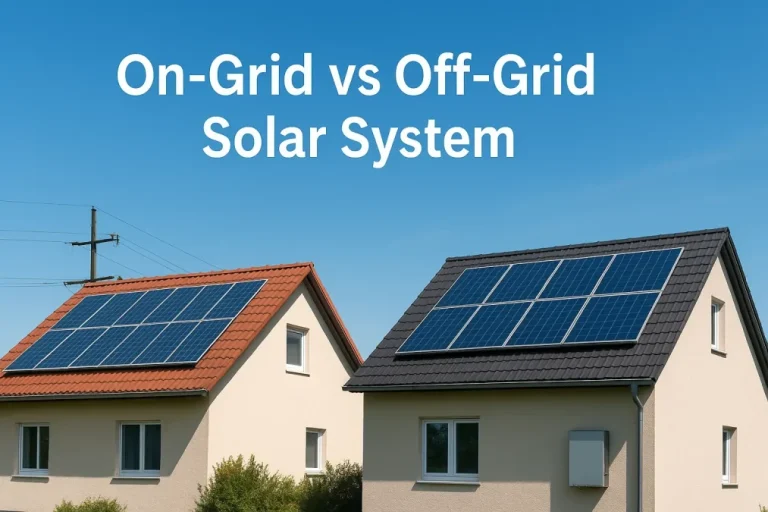
On-grid, hybrid or off-grid?
On-grid for daytime use
A basic grid-tied installation can supply daytime loads while the utility is available. It normally shuts down during an outage. Approved surplus export and settlement depend on the connection arrangement; do not assume exported units have the same value as imported units.
Hybrid where defined backup is required
A suitable hybrid design may combine PV, grid and storage. Ask which essential circuits it supports and its backup-output limits. The word hybrid is not a promise that every appliance continues operating or that batteries are included in the price.
Off-grid where utility support is unavailable
A standalone design must cover demand through changing sunlight and night use. Storage, charging and any fallback source need to be assessed together. A nominal 3kW array cannot guarantee continuous energy in all seasons.
Read the system-mode comparison before comparing prices. Different operating requirements produce different equipment budgets.
How much energy can a 3kW array produce?
Use equivalent peak-sun hours rather than counting every hour between sunrise and sunset as full-rated generation. Output depends on the location, season, orientation, shading, temperature and system losses.
Illustrative calculation: a 3.0kW array with an assumed 4.5 peak-sun hours and an assumed 20% combined loss would produce 3.0 × 4.5 × 0.80 = 10.8kWh/day. A 3.51kW array under the same assumptions would produce 12.636kWh/day. Neither figure is a local forecast or an every-day guarantee.
Ask for a monthly model with the source of irradiation data and stated losses. The solar calculator lets you explore assumptions; a purchase decision needs a site-specific design.
What appliances can it run?
The package name cannot answer this. List simultaneous demand and starting loads, and distinguish power in kW from daily energy in kWh. A refrigerator or pump may have starting requirements that a simple sum of typical running watts misses.
For example, a steady 1kW load running for four hours uses 4kWh. The inverter must support its instantaneous power, and the available source must deliver the energy. If backup is required, storage and its discharge limits must also meet that scenario.
Do not assume that 3kW is suitable for every small or medium home. Actual appliance use and roof conditions vary. Ask the installer to document the supported loads instead of promising a fixed number of fans or air conditioners without ratings.
Size backup separately
Choose essential circuits and desired runtime first. Suppose essential appliances total 300W and must operate for three hours. They need 0.9kWh delivered. With illustrative assumptions of 80% usable storage and 90% conversion efficiency, nominal energy would be 0.9 ÷ (0.8 × 0.9) = 1.25kWh.
Those assumptions are not battery specifications. Replace them with the selected model’s limits, account for reserve and ageing, and verify discharge power. Ask whether the bank can recharge before the next expected outage. See the battery planning guide.
Estimate savings without promising payback
Separate electricity used directly at home from exports. Avoided imports depend on the applicable bill structure; export value depends on the approved arrangement. Fixed charges, seasonal demand, maintenance, financing and replacement costs can affect the outcome.
A simple illustration can multiply self-consumed kWh by an explicitly chosen avoided import value, but it is not a forecast of the whole bill. Do not promise zero bills or three-year payback without a complete, stated financial model. Verify your own connection and tariff information with the responsible provider.
Before accepting the installation
- Match panels and inverter to the accepted model schedule.
- Keep serial records, invoices and applicable warranties.
- Receive the roof layout and commissioning documentation.
- Have the installer demonstrate normal and agreed backup operation.
- Confirm owner monitoring access and service contacts.
- Document connection approvals and unresolved work.
The installation handover guide provides the next checks. Use the authenticity workflow before the modules are mounted.
Example: two different “3kW” quotations
Suppose supplier A offers five 600 W panels and supplier B offers six 585 W panels. A contains 3.0 kW DC; B contains 3.51 kW DC, or 17% more rated panel capacity. Both may be sold with a 3 kW inverter description, but they do not contain the same array.
Before comparing total price, check full module codes, layout and inverter compatibility. Ask whether the additional panel capacity in B is useful at your site and within the proposed equipment limits. Do not assume it produces 17% more annual usable energy: clipping, shading, operating conditions and the timing of household demand can change the outcome.
Then align backup scope. If one offer includes a battery and protected circuits while the other does not, separate that cost before judging value. Ask both suppliers to price the same essential-load requirement if backup matters to you.
Finally, compare delivery, roof work, protection, commissioning, applicable taxes and warranty responsibilities. List excluded items in rupees where the supplier can quote them. Where a cost remains unknown, mark it unresolved rather than assigning zero. This turns the package comparison into a review of actual deliverables.
Retain the agreed component schedule with the payment milestones. If equipment changes before delivery, update the calculation and have the installer recheck the design. A consistent written schedule is more useful than accepting a larger panel count without knowing the corresponding model or operating conditions.
Frequently asked questions
What is the full 3kW price in Pakistan?
No verified national package total is asserted here. Compare dated installed quotations with the same panel capacity, operating mode, backup requirement and site scope.
Are six 585W panels exactly 3kW?
No. They total 3.51kW DC. The inverter may have a different rated AC output; ask for both figures.
Will 3kW eliminate my bill?
There is no such guarantee. Self-consumption, grid imports, fixed charges, seasonal generation and export settlement all matter.
Does a battery automatically power the whole house?
No. Backup circuits, inverter limits, available energy and discharge power determine what can operate.
Source and calculation policy
The linked supplier supports the dated component-price reference. All panel counts and energy examples show their inputs. They are planning arithmetic, not approved equipment combinations or promised household performance.

2 Comments