
Lithium Battery Price in Pakistan: Compare Capacity & Backup
Reviewed by Solar Energy Desk · Sources checked 22 October 2026 · Prices in PKR
Lithium battery prices in Pakistan depend on the exact model, voltage, stored energy and warranty. For a useful comparison, start with kWh, not ampere-hours alone. A 100Ah battery at 25.6V stores half the nominal energy of a 100Ah battery at 51.2V.
The table below contains selected published seller examples. It is a reference for comparing quotations, not a nationwide price survey or a guarantee of availability. Ask the seller to confirm delivery, taxes, installation and local warranty terms in writing.
Lithium battery price list: selected published examples
| Seller-listed battery | Capacity label | Listed price |
|---|---|---|
| iTel lithium battery | 51.2V, 100Ah | Rs. 230,000 |
| Dyness DL5.0X | 51.2V, 100Ah | Rs. 240,000 |
| MaxPower MP-5000 Ultra | 51.2V, 102Ah | Rs. 250,000 |
| SolaX TB-LD-51 | 51.2V, 100Ah | Rs. 200,000 |
| Soluna IP65 | 51.2V, 100Ah | Rs. 255,000 |
| Soluna IP20 | 51.2V, 100Ah | Rs. 248,000 |
Price source: BuySolar lithium battery catalogue, checked 22 October 2026. Seller labels can be rounded; verify rated and usable energy in the exact manufacturer datasheet. Stock and final selling prices have not been independently confirmed.
48V vs 51.2V lithium batteries: compare the energy
Nominal energy in kWh = voltage × ampere-hours ÷ 1,000. A 48V 100Ah battery has 4.8kWh nominal energy. A 51.2V 100Ah unit has 5.12kWh. Neither number is a promise of usable AC energy: allowed discharge, conversion losses and the battery condition affect what reaches your appliances.
Do not choose voltage simply because the larger number looks better. The inverter must support the battery operating range, charging settings and communications protocol. A manufacturer compatibility list and the correct firmware matter more than a generic claim that a brand works with every inverter.
How much battery backup do you need?
Size storage around the appliances you want to run during an outage. A 5kW or 10kW solar system rating alone does not tell you how much battery energy is needed. Record the expected load in watts and the required backup hours, then check both energy capacity and continuous discharge power.
Worked example: assume a 5.12kWh battery, 90% permitted discharge and 90% inverter efficiency. Estimated AC energy is 5.12 × 0.90 × 0.90 = 4.15kWh. At a constant 800W load, that is approximately 5.2 hours. At 2,000W, it is approximately 2.1 hours. These are calculations using stated assumptions, not measured product results.
Actual runtime changes with appliance cycling, standby consumption, temperature and battery limits. Motor starting loads also matter. Ask your installer to document the load, reserve setting and expected runtime rather than promising a fixed number of hours for every home.
Use our solar load calculator to prepare an appliance list, then have the proposed battery and protection design checked by a qualified installer.
LiFePO4, lithium-ion and gel: different labels matter
LiFePO4, also called LFP, is a lithium-ion chemistry. It should not be presented as a completely separate non-lithium-ion category. A gel lead-acid battery is not a lithium battery. Confirm the chemistry and full model code on the manufacturer label before comparing prices.
For a model-specific reference, Pylontech identifies its US5000 as a 48V LFP battery with 4.8kWh nominal capacity. Those specifications describe that model; they should not be applied to every battery carrying the same brand.
Heat, outdoor installation and battery safety
A battery management system monitors and protects a battery within its design limits; it is not a substitute for suitable installation conditions. Follow the manufacturer instructions for temperature, clearance, enclosure and placement. An IP rating alone does not establish that a unit is suitable for direct sunlight, flooding or every outdoor location.
For example, the US5000 manufacturer page lists different charging and discharging temperature limits. Use the exact manual for your proposed model. Avoid claims that every lithium battery automatically cools itself or is unaffected by Pakistan’s summer heat.
Questions to ask before paying a supplier
- What is the exact model, chemistry, nominal energy and usable energy?
- Does the inverter manufacturer support this battery and firmware?
- What are the continuous current and peak discharge limits?
- Which mounting, protection and communications accessories are included?
- Who handles warranty claims locally, and what proof is required?
- What limits apply to cycles, throughput, retained capacity and installation conditions?
If future expansion is important, confirm the manufacturer rules for parallel operation, compatible models and maximum unit count. Do not assume that any two batteries can safely be connected together.
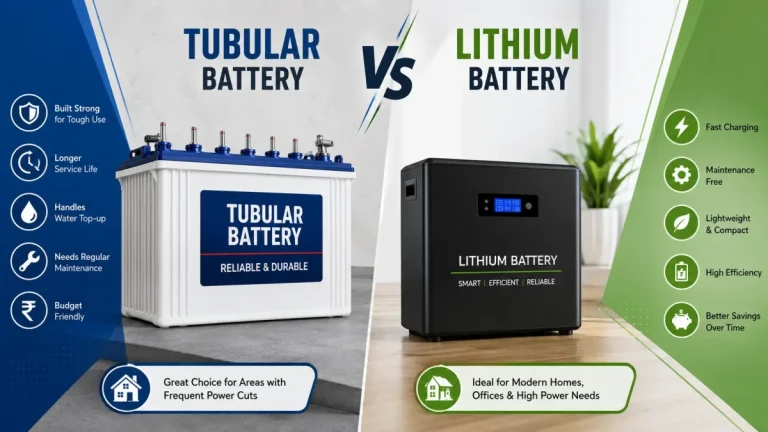
Is lithium better value than a tubular battery?
Compare the total installed cost against usable energy, required maintenance, warranted service and your expected use. A cheaper battery with less usable capacity may need a larger bank; a more expensive unit may still be unsuitable for your inverter or installation location. Neither chemistry is automatically the best purchase for every household.
Read the tubular battery guide alongside the current supplier quotations. Compare the same backup requirement and ask for the assumptions behind any savings calculation.
Price and specification corrections
This revision removes gel batteries previously mixed into the lithium table and corrects the 48V 100Ah energy calculation. We have replaced unsupported blanket lifespan and backup claims with model checks and explicit arithmetic. This is editorial research from public sources, not a laboratory test or a personal installation review.
Found a changed price or specification? Send the exact model, dated source and correction through our contact page.
Compare battery price per nominal kWh
Price per battery can be misleading when the capacities differ. Divide the battery-only quotation by its nominal energy to make a first comparison. On a hypothetical quote of Rs. 230,000 for a 5.12kWh battery, the arithmetic is approximately Rs. 44,922 per nominal kWh. This is an example, not an installed cost, a current offer or a measure of lifetime value.
Next compare usable energy and power limits. A battery with a lower purchase cost per nominal kWh may allow less usable capacity or have a lower continuous discharge rating. Ask for the exact datasheet and written warranty rather than converting every sales claim into the same universal benchmark.
Separate power from stored energy
A battery’s energy rating describes how much energy it stores. Its discharge power rating helps determine what load it can support at one time. A large energy capacity does not automatically permit a high-power appliance. The inverter and battery must both meet the demand, including relevant starting loads.
For example, an assumed usable AC energy budget of 4kWh supports an average 1kW load for about four hours arithmetically. It does not establish whether the equipment can start a motor or supply a short high-power peak. Ask your installer to check both questions separately.
Plan the service and replacement route
Keep the invoice, serial number, commissioning date, settings record and warranty document together. Ask whether the supplier or manufacturer receives a claim, whether transport is included, and what evidence will be requested. A quoted cycle count without its test conditions is not a guaranteed replacement date.
If storage is essential for work or medical equipment, discuss a suitable continuity plan with the relevant qualified provider rather than relying on a general buying guide. For an ordinary home installation, clarify how long a service assessment may take and who can safely isolate the unit if a fault occurs.
Related guides for your next decision
Compare batteries for the same required backup, voltage and usable energy. A model number or Ah label alone does not establish runtime. Continue with Tubular Battery Price In Pakistan and Phoenix Battery Price in Pakistan. Compare current solar panel prices by brand and wattage when preparing your itemised equipment budget.


7 Comments