

Tubular Battery Price in Pakistan: Prices & Backup Guide
Reviewed by Solar Energy Desk · Sources checked 22 October 2026 · Currency: PKR
Compare tubular battery prices using the exact model, voltage, capacity rating and warranty. The cheapest single battery may not provide the backup your home needs, and a higher Ah label is not a complete measure of value.
The selected Exide examples below are published retailer prices. They do not represent an official manufacturer price list, a nationwide average or a confirmed stock offer. Ask for a current written quotation with taxes, delivery, activation and any old-battery exchange allowance shown separately.
Exide tubular battery price examples
| Model | Published seller price |
|---|---|
| Exide TR-1500 | Rs. 46,000 |
| Exide TR-1800 | Rs. 55,000 |
| Exide TR-2000 | Rs. 62,000 |
| Exide TR-2500 | Rs. 71,000 |
| Exide TR-3000 | Rs. 73,000 |
| Exide TR-3500 | Rs. 83,000 |
Source: BuySolar Exide catalogue, checked 22 October 2026. Verify the current battery specification and final price directly with the supplier.
Phoenix, Osaka, Volta and AGS: request comparable quotes
For these brands, obtain a dated quotation for the exact model rather than substituting the price of another battery with a similar name. Phoenix publishes its product families and dealer information, which can help identify the correct purchasing route.
A missing price or zero-value catalogue placeholder is not a selling quotation. Only identified, dated source figures should be treated as manufacturer price references. A missing verified price should lead to a quotation request, not an invented amount.
Alaska tubular battery price in Pakistan: DC1600 example
Battery PK lists the Alaska DC1600 at Rs. 26,000, describes it as 130Ah with tubular technology, and states a nine-month warranty. Its product text limits delivery to Faisalabad. This is a seller listing checked on 23 October 2026, not an official Alaska price list or a confirmed stock quotation. View the seller’s DC1600 listing.
Do not confuse DC1600 with another battery carrying “1600” or treat the model number as its Ah rating. Before paying, confirm the label, voltage, capacity test rate, battery condition and written warranty. For an Alaska 1800 quotation, request the exact model specification and a dated price; the DC1600 price cannot establish the price or capacity of that different battery.
How to compare 12V 150Ah, 185Ah and 200Ah batteries
Nominal energy in kWh = voltage × Ah ÷ 1,000. On that basis, a 12V 150Ah battery represents 1.8kWh nominal energy; 12V 185Ah represents 2.22kWh; and 12V 200Ah represents 2.4kWh. Usable energy is lower and depends on the permitted discharge, load, battery condition and inverter losses.
Check the discharge-rate basis of the Ah specification. Do not treat capacities measured at different test rates as directly interchangeable, or assume that a model number is its Ah capacity. Have the installer verify the exact product datasheet.
What does a complete battery bank cost?
Ask how many batteries your inverter requires and which bank voltage it supports. A price for one unit is not necessarily the price of a working storage bank. Include compatible cables, protection, battery stands, installation and commissioning when comparing quotations.
Cost arithmetic example: if four required batteries are quoted at Rs. 62,000 each, the battery-only subtotal is Rs. 248,000. This is a quantity calculation, not a recommended wiring arrangement or a complete installed-system quotation.
Battery selection and connections should follow the inverter and battery manufacturer instructions. Confirm how a replacement or future expansion affects the existing bank; do not assume that batteries of different ages, capacities or types can be mixed.
Estimate backup from your actual load
List the appliances needed during load shedding, their power demand and the required hours. A solar-array size alone does not determine battery backup. Fans, refrigerators and air conditioners have different consumption patterns, so a claim of a fixed runtime for every household is misleading.
For a planning calculation, divide estimated usable AC energy in kWh by the average load in kW. Have your installer explain the discharge allowance, conversion losses and reserve setting used in that estimate. Use our solar load calculator to prepare your appliance list.
Maintenance, placement and warranty checklist
- Follow the exact manufacturer instructions for ventilation, clearance, temperature and maintenance.
- For a serviceable flooded battery, confirm the required inspection and water-maintenance schedule with the supplier.
- Ask the installer to set the correct charging profile and protection for the battery type.
- Get the warranty period, exclusions, claim location and invoice requirements in writing.
- Keep the model, serial number, installation date and purchase proof together.
Do not assume that tubular construction makes a battery immune to heat, overcharging or deep discharge. Avoid universal lifespan promises: operating conditions and the warranty terms matter.
Tubular or lithium for a solar system?
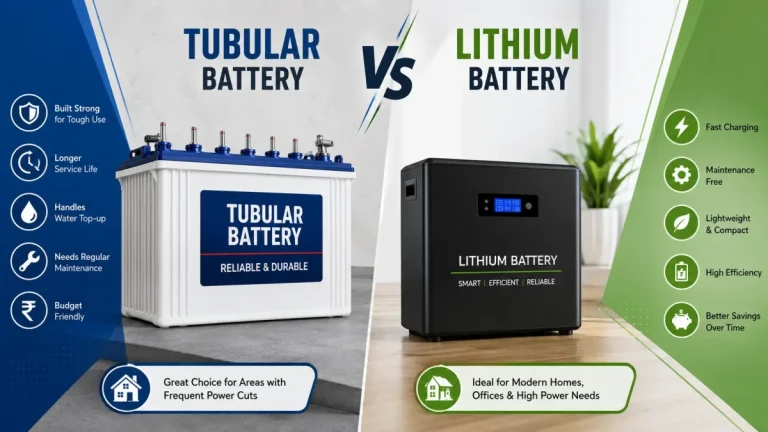
Compare both options for the same required backup, usable energy and installed scope. Consider maintenance, inverter compatibility, replacement cost and the warranty evidence. Our lithium battery price and capacity guide includes voltage comparisons and an explicit runtime example.
This page is public-source buying guidance, not a product test or a stock catalogue. Report a price change with a dated source through our contact page.
Compare the total bank before comparing brands
A quoted single-battery price is only the first line of a storage budget. Ask the installer for the required number of matched units and the bank voltage supported by your inverter. Compare the same installed backup requirement across brands, including the accessories and work needed to operate the bank safely.
Create a worksheet with battery model, quantity, rated voltage, Ah capacity, rating conditions, warranty and delivered price. Keep any exchange allowance for an old battery on a separate line. This makes it possible to see whether a lower advertised price depends on returning an old unit or excludes activation and delivery.
Use the model specification, not just the name
A model label containing “2000” is not automatically a statement of 200Ah capacity. Check the manufacturer specification and the capacity rating conditions. Ask whether the quotation is for a new, activated, dry-charged or other supplied condition, and who is responsible for preparation before commissioning.
For an illustrative comparison, two batteries described as 12V 200Ah each represent 4.8kWh of combined nominal energy. That arithmetic does not specify their wiring or the amount of AC energy available to your appliances. A qualified installer must match the bank configuration and operating limits to the equipment.
Make a realistic backup worksheet
List each essential appliance, its typical running power and the hours it is expected to operate. Keep continuously running devices separate from cycling loads such as a refrigerator. Use measured consumption or the relevant product information where available, and explain uncertainty instead of treating every appliance as a constant load.
Add the expected energy use in kWh, then discuss permitted discharge, inverter losses and the reserve allowance with the installer. A bank designed only around ideal nameplate energy can provide less backup than expected. Starting demand and the inverter’s power limits also need attention.
Keep a maintenance record
At handover, ask for the correct inspection schedule and manufacturer instructions for your specific flooded battery. Record checks and service visits with dates. Do not open sealed equipment, add arbitrary chemicals or change charging settings based on an unrelated online recommendation.
Discuss safe placement, ventilation, access and protection from children. Batteries are heavy and contain hazardous materials; installation, movement and electrical work should be handled appropriately. Ask the supplier about the return or recycling route for a replaced unit rather than putting it into general household waste.
What to keep for a warranty enquiry
Save the invoice, serial numbers, model information and installation date. Record the symptoms, when they started and any displayed inverter or charger alarms. A clear history helps the supplier distinguish a product issue from an installation or charging problem. Avoid repeatedly changing settings while collecting evidence.
Confirm which party will inspect the battery and whether collection, testing or transport has a separate charge. Written service terms are more useful than a broad promise that every battery will last a fixed number of years. Compare the documented support route alongside the price and your maintenance obligations.
Related guides for your next decision
Compare batteries for the same required backup, voltage and usable energy. A model number or Ah label alone does not establish runtime. Continue with Phoenix Battery Price in Pakistan and Tubular Battery vs Lithium Battery. Compare current solar panel prices by brand and wattage when preparing your itemised equipment budget.




3 Comments