
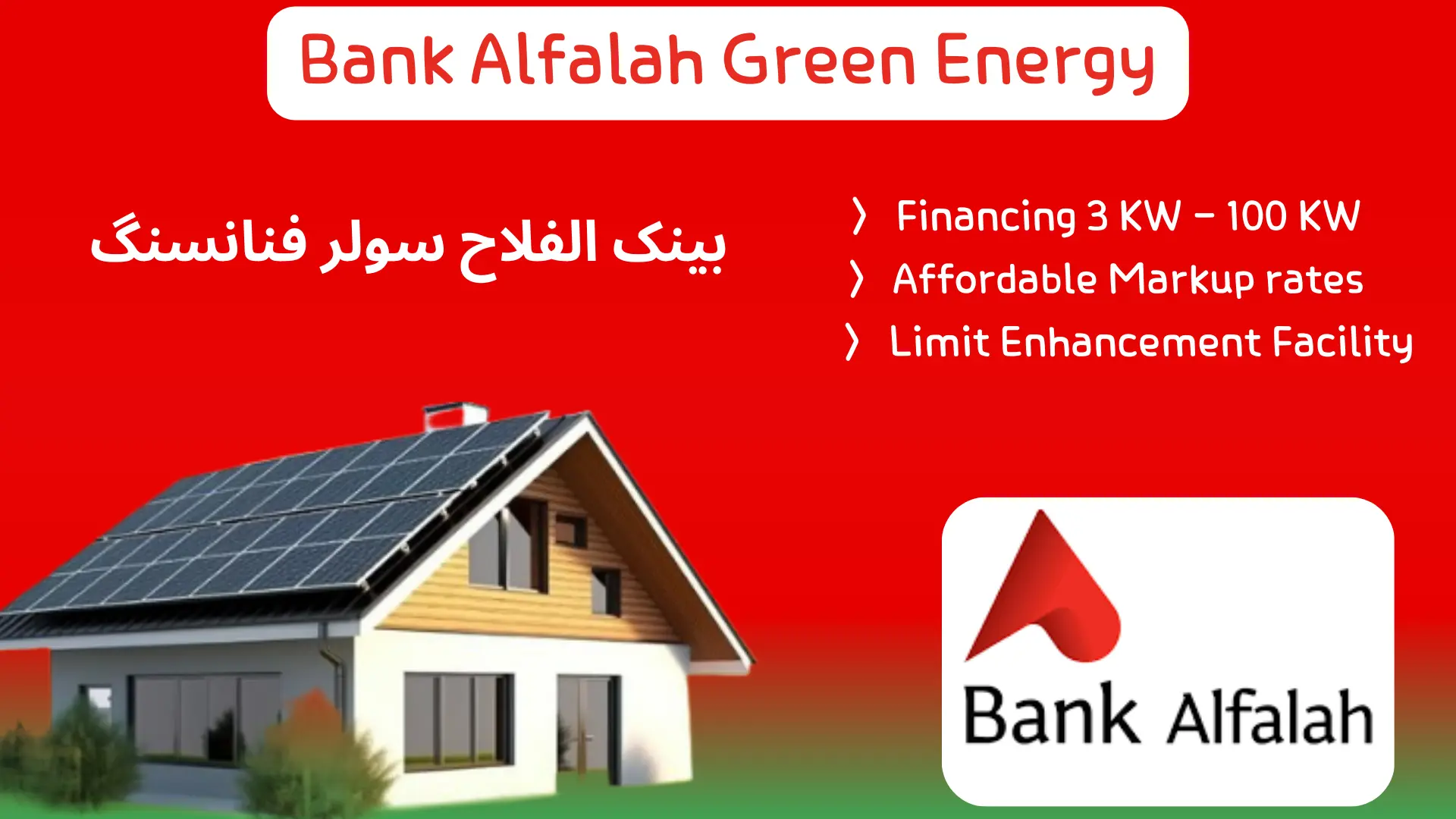
Bank Alfalah Green Energy: Solar Financing & Eligibility
Compare the current conventional Green Energy facility, repayment basis and application requirements before financing a solar system. Official product page checked 23 October 2026. This is an independent guide, not a bank application or offer.
View Bank Alfalah’s official Green Energy terms and application channel
Current published terms at a glance
| Item | Official product summary |
|---|---|
| System size | 4–1000kW |
| Pricing | Variable KIBOR + spread |
| Tenure | Up to 5 years; 3-month grace period |
| Repayment | Monthly, quarterly or bi-annually |
| Vendors | Pre-approved, AEDB-registered vendors |
| Residential limits | Published caps: PKR 2.5M for rented premises; PKR 4M for owned premises |
| Assessment | Credit record, relevant utility history, survey and category-specific security requirements |
Confirm the current category-specific conditions directly. Use the terms for the named product and borrower category in your written offer.
Bank Alfalah solar financing: identify the actual product
Ask the bank which facility applies to your project before comparing rates. Green Energy, Islamic Green Finance, a credit-card instalment offer and a mortgage-related product should not be treated as one agreement. A feature found on an old leaflet or another product page may not apply to the facility offered to you.
This guide concerns the conventional Green Energy product linked above. Keep each product’s pricing, processing requirements and repayment basis separate. If you want an Islamic option, obtain its own current product terms and payment schedule rather than assuming conventional and Islamic facilities share identical features.
How KIBOR plus spread affects the comparison
A KIBOR-linked rate contains a benchmark and the bank’s stated spread. Ask for the benchmark tenor, the spread, when pricing resets and the method used to calculate each payment. The current official product page does not establish one universal fixed percentage for every applicant.
For arithmetic only, a hypothetical benchmark of 10% plus a hypothetical spread of 3 percentage points equals 13%. These are invented inputs for explaining the calculation, not today’s KIBOR or a Bank Alfalah quote. Use your written offer’s actual figures. A monthly payment cannot be determined from this percentage alone without the repayment basis and schedule.
Request a complete repayment schedule
Compare the total commitment using the actual payment dates, principal amounts, markup and charges. The product offers more than one repayment frequency; a monthly amount should not be compared directly with a quarterly amount. Ask the bank for a schedule that uses the same project cost and proposed drawdown timing.
Review the grace period carefully. Ask what becomes payable during and after that period and whether amounts accrue or are deferred under your agreement. A grace period does not automatically mean free financing. Check early-settlement terms, insurance and any separately paid items using the applicable schedule of charges and written documents.
Residential, SME, commercial and agricultural projects
Different borrower categories can have different limits, security and eligibility requirements. Explain the property use, ownership, business activity and intended system size accurately. Do not assume a residential income threshold from another solar product applies to an agricultural or business facility.
Ask which category the bank is assessing and request the corresponding document checklist. Clarify whether a condition is mandatory for your application or depends on the assessment. A general website guide cannot determine approval or substitute for the bank’s credit decision. Keep a dated copy of the checklist with the equipment quote.
Property ownership and installation permission
Check who owns the installation site, who can authorise the work and which consents the bank requires. Jointly owned property can involve more than one person. A rented site also needs clarity about installation permission, the term of occupation and responsibility if the system must be moved.
Give the bank consistent property details across the application, utility bill and vendor survey. Ask how a change of ownership, tenant or project site would affect the facility. Resolve those questions before ordering equipment; a financing approval and permission to alter a building are different requirements.
Approved vendors and payment responsibility
Ask the bank for its current pre-approved vendor process and confirm the exact supplier for your project. A company’s marketing statement or appearance in an old list does not establish current approval. Request the itemised quote through the required channel and verify who receives the payment.
Separate the bank’s role from equipment supply and workmanship. Find out who handles a product fault, a roof issue, a commissioning delay or a warranty claim. Keep the agreed model schedule and service responsibilities with the financing records. Bank approval of a vendor is not a promise of fault-free operation.
Prepare a useful solar-equipment quotation
Ask for panel model, wattage and quantity, total DC capacity, inverter model, operating modes and any battery proposal. Mounting, electrical protection, cabling, commissioning and delivery should have a clear scope. Identify tax treatment and exclusions instead of relying on a broad complete-system label.
Compare the proposed design with the consumption and site survey. A 5kW or 10kW sales label alone does not state backup capability or usable storage. Any equipment change after approval should be reflected in the quote and financing documents. Do not assume that a calculator for the original package covers later additions.
Budget for costs outside the financed amount
Make a cash budget alongside the repayment schedule. Ask which equipment, installation, insurance, application, documentation and connection items are included in the sanctioned facility and which must be paid separately. Obtain the applicable charges and upfront contribution from the written offer.
Record each extra once so that the same charge is not counted twice. Ask what happens to a deposit if the site survey changes the design or the application is not approved. Keep receipts and the final scope. The equipment price, financed amount and total amount payable are three separate figures.
Do electricity savings cover the instalments?
Assess this using a household or business budget, not a universal promise. Solar production varies by month, and the value of energy depends on when it is consumed and your applicable electricity arrangement. A sunny-day generation screenshot does not establish annual bill savings.
Compare a cautious scenario with the vendor’s estimate. Keep remaining electricity imports, fixed charges, maintenance and potential component replacement visible. If financing costs can change with the benchmark, ask how a higher-rate scenario affects affordability. The project should remain understandable even when savings are below the seller’s best-case illustration.
Application checklist and next steps
Start through the official bank page or branch and request the current category-specific checklist. Prepare the requested identity, financial, business or employment, utility and property records as applicable. Do not publish sensitive documents in public groups or send them to a seller claiming to guarantee bank approval.
Obtain the required vendor survey and quote, then review the written offer before committing. Confirm the payment schedule, security, insurance, fees, equipment scope and obligations. This website does not collect applications, approve customers or promise a processing deadline. The bank’s assessment and signed agreement govern the facility.
Questions to settle before signing
Ask for a written answer where the quote and offer disagree. Which product am I receiving? Which benchmark and spread apply? How and when can payments change? What happens during the grace period? Which security and insurance obligations remain throughout the term?
Also ask about equipment substitutions, delivery delays, cancellation and early settlement. Clarify who resolves installation defects and where warranty claims go. Keep the final documents together and check that applicant name, property, supplier, system scope and amounts are consistent. Do not rely on another customer’s experience as your contract terms.
Bank Alfalah Green Energy FAQs
Is the rate a fixed subsidised percentage? The current linked conventional product describes variable KIBOR-linked pricing; obtain the actual spread and schedule from the bank. Does the guide guarantee eligibility? No. The bank applies its current requirements to your application and category.
Can the same terms be used for Islamic Green Finance? No; request that product’s own current documentation. Is every battery or net-metering expense included? Ask for the approved scope and exclusions in writing. Does solar guarantee uninterrupted power? Backup needs a suitable technical design and operating arrangement; financing alone does not establish that capability.
Compare related guides
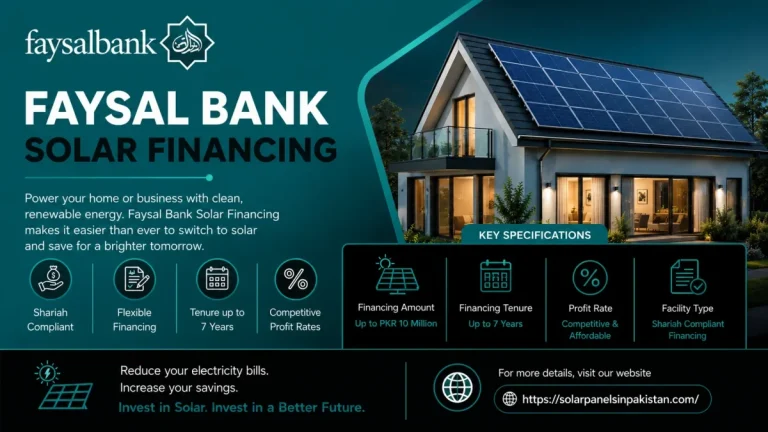
See Meezan solar financing and calculator, Faysal Bank solar financing, the 5kW system guide and solar panel prices by brand. Compare each bank’s own current terms rather than treating facilities as identical.
One Comment