
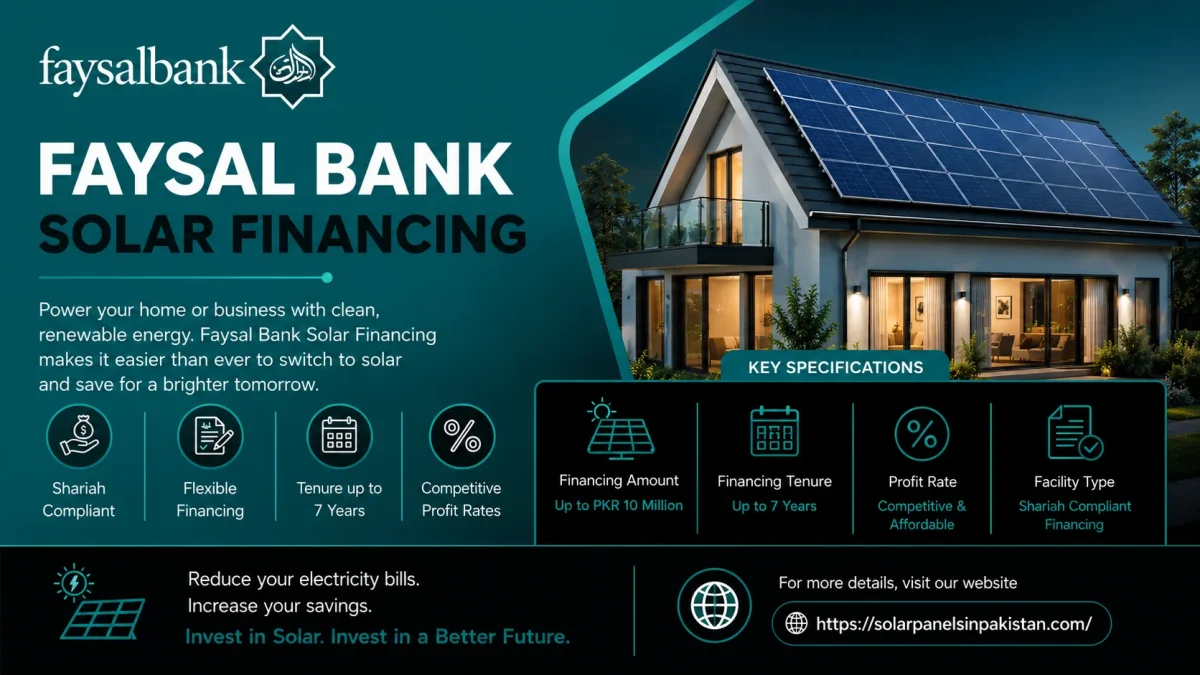
Faysal Bank Solar Financing: Eligibility & Instalments
Official product information checked 22 October 2026 · Independent informational guide
Faysal Islami Solar Ease is a domestic solar financing product based on Diminishing Musharakah. The bank and customer share ownership, and the customer gradually purchases the bank’s share. Check the official terms and payment schedule before comparing this facility with an upfront equipment purchase.
Official Solar Ease terms & calculator ↗
Published Solar Ease terms
| Item | Bank’s published information |
|---|---|
| Financing range | PKR 100,000–10,000,000, subject to assessment |
| System capacity | 4–50kW; on-grid and off-grid |
| Salaried pricing | Variable: 1-year KIBOR + 3% |
| Self-employed pricing | Variable: 1-year KIBOR + 3.5% |
| Minimum monthly income | Salaried: PKR 100,000; self-employed professionals/businesspeople: PKR 150,000 |
| Location and property | Karachi, Lahore, Islamabad/Rawalpindi; constructed houses, not apartments |
| Vendor and batteries | Bank-approved vendors only; off-grid financing can include battery cost |
Source: Faysal Bank’s official product page. Confirm current eligibility, location coverage and costs with the bank.
How to apply through official channels
- Read the official product page and ask the bank whether your property, income and location qualify.
- Use its official Solar Solution application page or contact a branch.
- Request the current document checklist and an approved vendor’s itemised quotation.
- Review the written offer, payment schedule and total costs before accepting.
Use the bank’s own site for identity and financial documents. This independent guide does not collect applications or promise approval.
Faysal solar financing calculator: compare payment estimates
For a useful payment estimate, keep the quoted project cost, upfront contribution, financing term and pricing basis together. Use the official bank channel linked above for the actual calculation and request its written schedule. Compare all payments and separately charged costs; dividing the equipment balance by the number of months is not an approved instalment quote.
Understand a KIBOR-linked rate
A variable benchmark and a margin are separate parts of the pricing. To illustrate the arithmetic, if a hypothetical benchmark were 10% and the margin were 3 percentage points, their sum would be 13%. This is an example, not today’s KIBOR or a customer quotation.
Ask which benchmark date applies, when the rate is reviewed, and how a change affects the payment schedule. A lower initial monthly figure does not tell you the full cost over the facility’s life.
Run an affordability check: compare your proposed payment with a less favourable scenario. Ask the bank to show the effect of a higher benchmark so you can judge whether the commitment still fits your household budget.
Compare financing and installation separately
Start by comparing the equipment itself. Two offers may use different inverter models, panel quantities or battery capacities even when both are described as a “5kW system”. Ask for the same equipment specification and installation scope before comparing prices.
Next, compare the upfront payment, scheduled payments, separately charged costs and settlement terms. Do not count estimated electricity savings as guaranteed money available for instalments. A household with high evening consumption can have a different savings pattern from one using most electricity in daylight.
Check the handover documents
Before installation is treated as complete, keep the equipment model list, serial numbers, written warranties and installer’s contact details. Ask for an explanation of monitoring, isolation procedures and who handles faults. Resolve missing equipment or paperwork through the agreed bank and vendor channels.
For a battery-backed proposal, ask which appliances are connected to backup circuits and what assumptions support the stated backup time. A battery’s nameplate capacity alone cannot tell you how long your particular appliances will run.
Frequently asked questions
Is the calculator result an approved offer?
No. Use it for an initial estimate and obtain the bank’s written quotation and schedule. A calculator does not confirm your credit assessment or final project scope.
Can this guide confirm my eligibility?
No. Your documents and circumstances must be assessed by the bank. Check the current requirements before paying for a survey or arranging equipment.
How can I compare my equipment quote?
Check panel model, wattage, quantity, inverter specification, battery details and installation scope. Use the solar panel price reference as a comparison aid, then obtain a current supplier quote.
Compare the Meezan financing guide → · Plan your solar load →
Prepare an itemised Solar Ease comparison worksheet
Before requesting a payment estimate, create a one-page project worksheet. Put the proposed equipment cost at the top, then list your available upfront contribution and the amount you can reliably set aside each month. Keep household living costs, existing commitments and emergency reserves separate from the solar budget. This worksheet is for your own comparison; it does not replace the bank’s assessment.
Record the exact date of each quotation. Give every supplier the same panel quantity, inverter requirements and backup expectations. If a vendor changes a model, request a revised quote instead of comparing it with an older specification. The financing amount can look similar while the delivered system differs substantially.
Keep four cost columns
Use separate columns for the equipment and installation price, upfront payments, scheduled financing payments, and items paid outside the facility. Put each charge into one column so it is neither omitted nor counted twice. Ask the bank which charges are included in its stated total and which must be paid separately.
For a hypothetical equipment price of PKR 1,200,000 and an upfront contribution of PKR 300,000, the remaining equipment balance is PKR 900,000. This subtraction does not calculate a financed sale price, rental schedule, markup or final total payable. Use the written bank schedule for those figures. Keep the example separate from the bank’s actual offer.
Compare backup requirements before accepting the vendor quote
If backup is important, write down the appliances that must run during a power cut and the hours needed. Ask the vendor to identify the backup circuits and document the assumed average load. A large panel array cannot by itself provide night-time energy, and a battery nameplate is not a guarantee of runtime.
Check the battery and inverter model pairing, any communication accessories and the warranty conditions. Ask how faults will be handled while the financing continues. The equipment service process and the repayment obligation are different matters; obtain the relevant terms in writing rather than relying on an informal verbal assurance.
Discuss changes before equipment is delivered
A site survey can reveal shading, restricted roof access, structural concerns or extra work absent from the first quote. Ask how a change in scope affects approval, your contribution and the payment schedule. Keep a revised dated equipment list. Do not assume that a replacement inverter or a different battery is automatically covered by the original proposal.
Arrange the handover around the agreed scope. Keep invoices, equipment identifiers, warranty documents and monitoring instructions together. Ask the installer to demonstrate normal operation and explain whom to contact for a fault. Electrical settings and protection should be commissioned by a qualified person.
Review affordability with cautious assumptions
Prepare a scenario with lower electricity savings than the vendor expects, and another with an unexpected household expense. These scenarios help test your own budget; they do not predict future tariffs or benchmark rates. Ask the bank for the payment consequences of its relevant repricing and settlement terms.
Before submitting sensitive documents, verify that you are using the bank’s official channel. This independent website does not need your CNIC, account statements or bank credentials. Keep copies of your application and the bank’s responses. If a condition is unclear, request written clarification before you commit to the facility or make a related payment.
Related guides for your next decision
Compare the complete payment schedule and total project cost before choosing a facility. Approval and final terms belong to the bank. For alternative product research, see Meezan Bank Solar Financing and JS Bank Solar Financing. Compare current solar panel prices by brand and wattage when preparing your itemised equipment budget.




I want to apply for solar
Respected Sir, the Bank’s official website links, which are underlined in the article, can be accessed through the official website for the application.
Hello.
Very Good article.
Good luck 🙂